
The space under the stairs is the most overlooked square metre in many homes. It is too small for a sofa, too awkward for a dining table, and often ends up holding shoes, boxes, and things nobody wants to look at. Yet it has one quality a home office needs above almost everything else: it is a defined, separate spot that nobody else in the house is using. With the right setup rules, a home office under the stairs can become a calm, permanent desk instead of a cramped experiment you abandon after a week.
The nook will never behave like a real room, so the goal is not to pretend it does. The goal is to fix its weak points — headroom, light, air, and power — before you spend anything on furniture. This guide works through those rules in order, so you can judge your own staircase honestly and build only what will genuinely work.
Quick Answer
A home office under the stairs is usable when you can sit down and stand up without ducking, light the desk properly instead of relying on one ceiling bulb, run power safely along the wall, and keep fresh air moving through the space. Choose a shallow desk that follows the slope, store low items in the deep corners, and keep the chair zone clear. Fix those basics and the nook becomes a quiet, permanent workspace.
- Measure headroom where you will sit and where you will stand to sit down.
- Plan light and power before you buy a desk.
- Use the lowest, deepest corners for storage, not for your chair.
- Leave the walking route past the stairs completely clear.
Rule 1: Check the Headroom Honestly
Under-stairs spaces fail most often at head height. The slope that looks generous when you stand back can leave you ducking every time you sit down or stand up, and a desk you have to crouch into will not survive a month of daily use. Measure the ceiling height at two points: directly above your chair, and at the spot where you stand just before you sit. You need comfortable standing height at the entry point, and enough seated height that you never feel the slope pressing down on you.
If the tallest part of the nook is near the open end, put the desk there and let the low end hold storage instead. This is the same judgment you make with any awkward leftover space: our guide on where to put a home office when you have no spare room compares under-stairs spaces with closets and landings, and headroom is the first filter for all of them. Be honest at this stage. A nook that fails the headroom test makes a brilliant storage cupboard and a miserable office.
Rule 2: Fix the Light Before Anything Else
Stair nooks are dark by design. Most have no window, and the light from the hall rarely reaches the back wall. Working all day under one dim ceiling bulb makes the space feel smaller and leaves your face in shadow on video calls. Plan two light sources instead: a main lamp that lights the whole nook softly, and a desk lamp you can aim at papers and at your face. A lamp with an adjustable arm is ideal, because the sloping ceiling limits where you can place tall fittings.
Light colour matters here too. A warm-neutral bulb feels calm and makes the small space feel welcoming, while a harsh blue-white bulb makes it feel like a cupboard with a desk in it. If the nook receives any borrowed daylight from a nearby door or hall window, place the desk so the light falls from your side, never from behind your screen. The measuring and placement routine in our guide to a small home office in a corner works for a stair nook as well — the shape is different, but the light rules are the same.

Rule 3: Solve Power Safely, Once
Older stair cupboards often have no socket at all, and the nearest one may be across the hall. Do not solve this with a cable trailing across the floor where people walk. Run a single extension lead along the wall or skirting board to a fixed point behind the desk, secure it with cable clips, and plug everything into that one point. If the nook is a long-term workspace, asking an electrician to add a proper socket is one of the best upgrades you can make, and it is often simpler than people expect.
Count your devices before you start: a computer or laptop, a monitor, a lamp, and a phone charger usually need four sockets. Add them up, choose a lead with enough sockets and capacity, and keep the whole cable path out of the foot zone. Power is unglamorous, but in a small nook it decides whether the setup feels finished or temporary.
Rule 4: Keep the Air Moving
A closed stair nook with a computer, a lamp, and a seated person warms up faster than a normal room, and stale air makes concentration fade long before you notice why. If the nook has a door, work with it open whenever you can. A small, quiet desk fan aimed gently across the space keeps air moving without blowing papers around. If your stair cupboard has a vent or a gap under the door, do not block it with storage boxes.
Warmth also affects your equipment. Keep the back of a computer or monitor clear of the wall and of stacked items so heat can escape. If the nook still feels stuffy within an hour even with the door open and a fan running, it may be better suited to short tasks than to full working days — another honest limit worth knowing before you commit to it.
Rule 5: Choose a Desk That Follows the Slope
Standard desks are rectangular; stair nooks are triangles. A shallow desk, around 45 to 55 cm deep, placed against the tallest wall usually works better than a deep desk forced into the space. Some people use a simple worktop cut to fit the nook exactly, resting on battens fixed to the walls. That uses every centimetre, avoids chunky desk legs, and leaves the floor clear for your chair and feet.
Think about what the desk must hold, and nothing more: screen, keyboard, notebook, lamp. If the space also has to stay flexible for other uses, a fold-away home office approach may serve you better than a fixed desk, with the nook becoming storage for a setup that opens out when needed. Either way, keep the surface small and honest. A desk that exactly fits its job stays tidy, while an oversized one collects everything the household cannot place elsewhere.
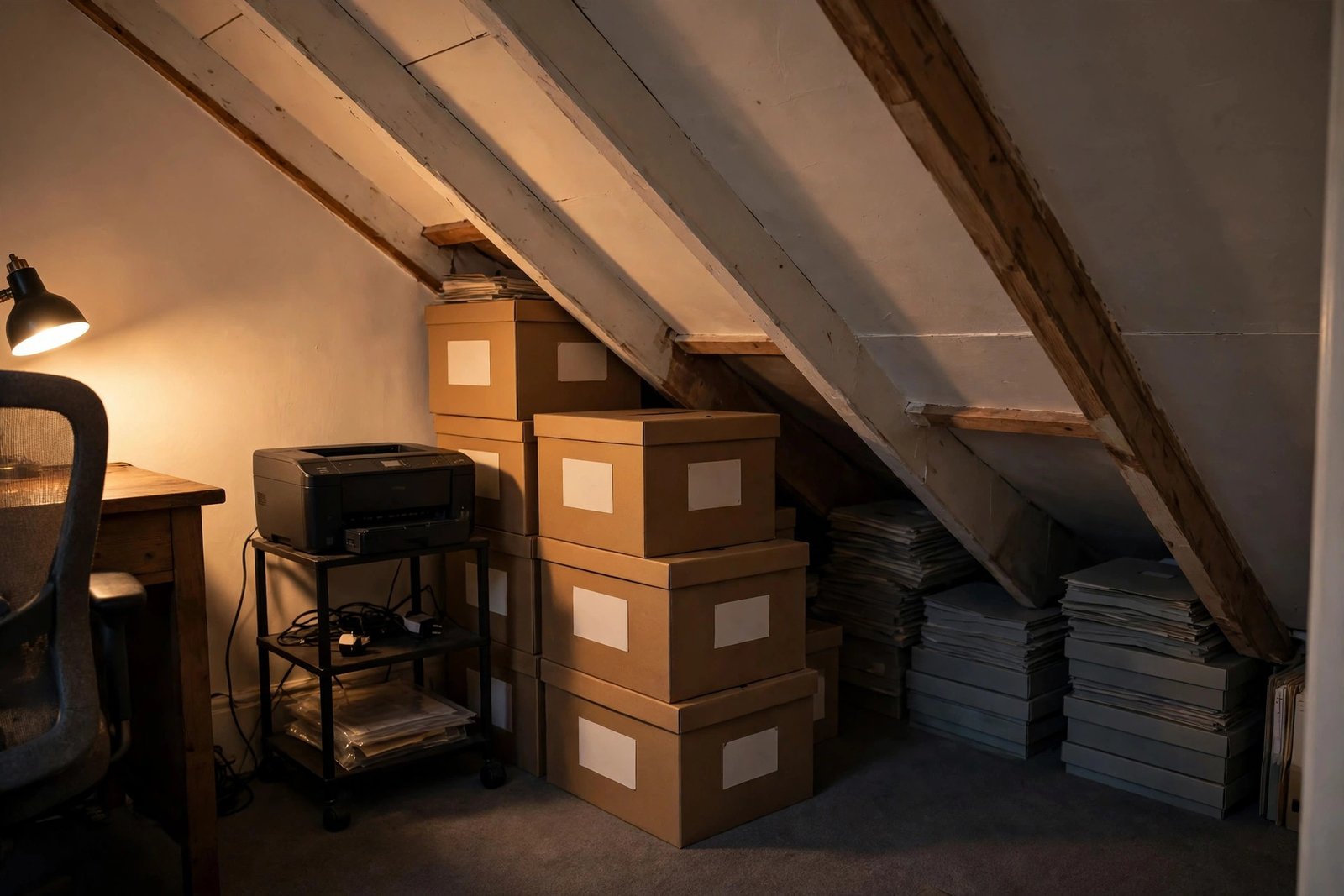
Rule 6: Store Low, Store Deep
The low, deep corners under the slope are useless for sitting but perfect for storage. Low boxes, archive files, a printer on a small stand, and spare supplies all belong at the dark end of the nook, clearly labelled and rarely needed. Keep daily items — notebook, pens, charger — within arm’s reach of the chair, so you never have to climb into the slope in the middle of a task.
Use the wall above the desk carefully. A short shelf at seated eye level can hold reference books and a small plant, but do not hang shelves anywhere your head passes when you stand up. In a sloping space, every fixed item should be checked against the stand-up path, not just against the sitting position.
Mistakes to Avoid
- Putting the chair under the lowest part of the slope. You will duck all day and quietly stop using the desk.
- Working in the dark with one ceiling bulb. Two planned light sources change the space completely.
- Running a loose cable across the walkway. It is a trip hazard in one of the busiest parts of the house.
- Blocking the only airflow with storage boxes. A stuffy nook defeats focus within the hour.
- Buying a full-size desk and hoping it fits. Measure the triangle, not just the floor plan.
- Letting the nook become general household storage again. Once the boxes creep back, the office is gone.
Frequently Asked Questions
How much headroom does an under-stairs office need?
You need to stand up from your chair without ducking, and sit without the slope feeling close above you. If the entry point of the nook makes you crouch, place the desk at the tall, open end and use the low end for storage only.
Can I work under the stairs all day?
Yes, if light, air, and power are properly solved and the headroom passes the stand-up test. If the space stays dark or stuffy after those fixes, it will suit shorter working sessions better than full days.
What desk fits best under the stairs?
A shallow desk around 45 to 55 cm deep, or a simple worktop cut to fit the nook, works best. The desk should sit against the tallest wall and hold only your screen, keyboard, notebook, and lamp.
How do I light an under-stairs desk with no window?
Use two sources: a soft main lamp for the whole nook and an adjustable desk lamp for tasks and for your face on calls. Choose warm-neutral bulbs, and aim the light from your side rather than from behind the screen.
Conclusion
A home office under the stairs works when you respect the shape instead of fighting it. Pass the headroom test, plan light and power before furniture, keep the air moving, fit a shallow desk to the slope, and store low and deep. Do those things, and the forgotten nook under the stairs becomes the quietest and most permanent desk in the house.
