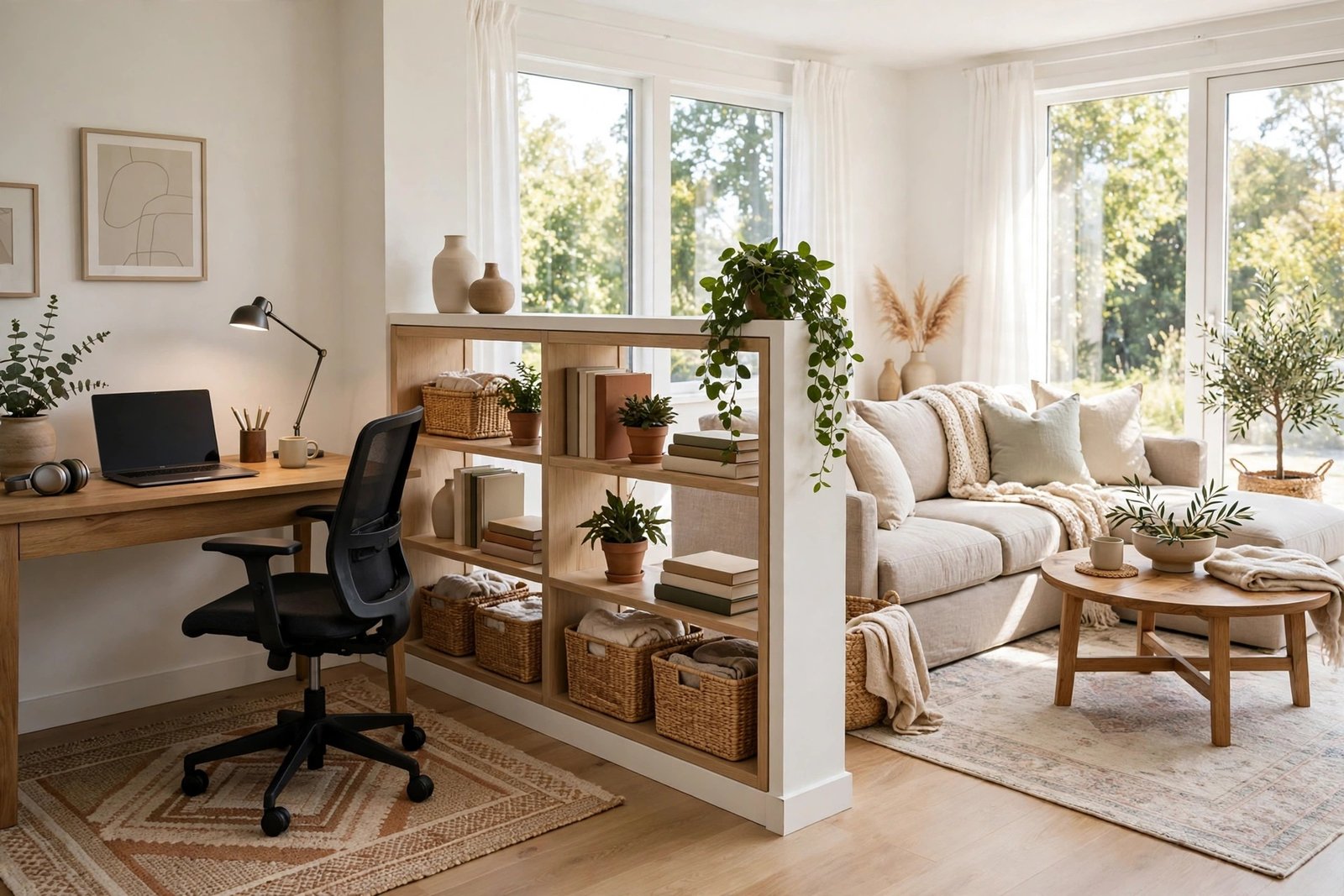
For many households, one room has to do two jobs: it is the office from nine to five and the family room for everything else. Children play a few feet from your desk, your partner relaxes on the same sofa you face on calls, and family life carries on around your working day. A home office and family space in one room can work well, but only when the room itself makes the boundary clear. Goodwill alone wears out within a fortnight.
The answer is not to banish the family or to work in a state of siege. It is to divide the room into honest zones, give work a visible edge, and agree a small set of signals that everyone, including young children, can understand at a glance. This guide covers the layout, the signals, and the daily reset that keeps both uses of the room healthy.
Quick Answer
To share one room between a home office and family space, divide it into zones with furniture rather than promises. Put the desk in a defined corner with its back to a divider or wall, mark the work zone with a rug, shelf, or screen, and agree on one clear working signal such as a closed screen or headphones. Keep work items inside the zone, give family life its own comfortable territory, and reset the room at the end of the day so it becomes a family room again.
- Zones drawn with furniture hold; zones drawn with words do not.
- Work needs a visible edge: a rug, a screen, a bookcase, a change of light.
- One simple signal, understood by everyone, prevents most interruptions.
- The end-of-day reset protects the room’s second life as family space.
Why Shared Rooms Fail Without Physical Boundaries
When work and family share a room with no visible division, both sides lose. The worker feels watched, interrupted, and guilty; the family feels hushed, excluded, and unsure what is allowed. Every small decision, “can I turn the television on, can I ask a question, can the children play here”, has to be negotiated again, several times a day. That constant negotiation is exhausting for everyone.
Physical boundaries end the negotiation. A bookcase that marks the office corner, a signal that means “in a meeting”, and a shared understanding that the desk zone is work territory during work hours answer most questions before they are asked. Children in particular respond far better to visible edges and simple signs than to abstract rules about being quiet.
Divide the Room With Furniture, Not Promises
Start with the desk position. The calmest spot is usually a corner against a wall, with the family area behind or beside you rather than in front of you. If you are still choosing the spot, the comparisons in our guide to where to put a home office when you have no spare room will help you judge corners and shared spaces honestly before you move anything heavy.
Then draw the edge of the work zone. A rug under the desk and chair is the simplest marker: inside the rug is the office. A low bookcase or storage unit placed at right angles to the wall both divides the space and gives you storage. A folding screen adds a taller, more private edge and can be opened or closed as the room changes use. Curtains on a ceiling track or tension rod work in rented homes where nothing can be fixed.
Give the family zone the same care. If the rest of the room is comfortable and complete, with seating, toys, and the television properly arranged, the family has somewhere to be, and the work zone stops being the most interesting place in the room to wander into.
Set Up the Desk Corner to Fend for Itself
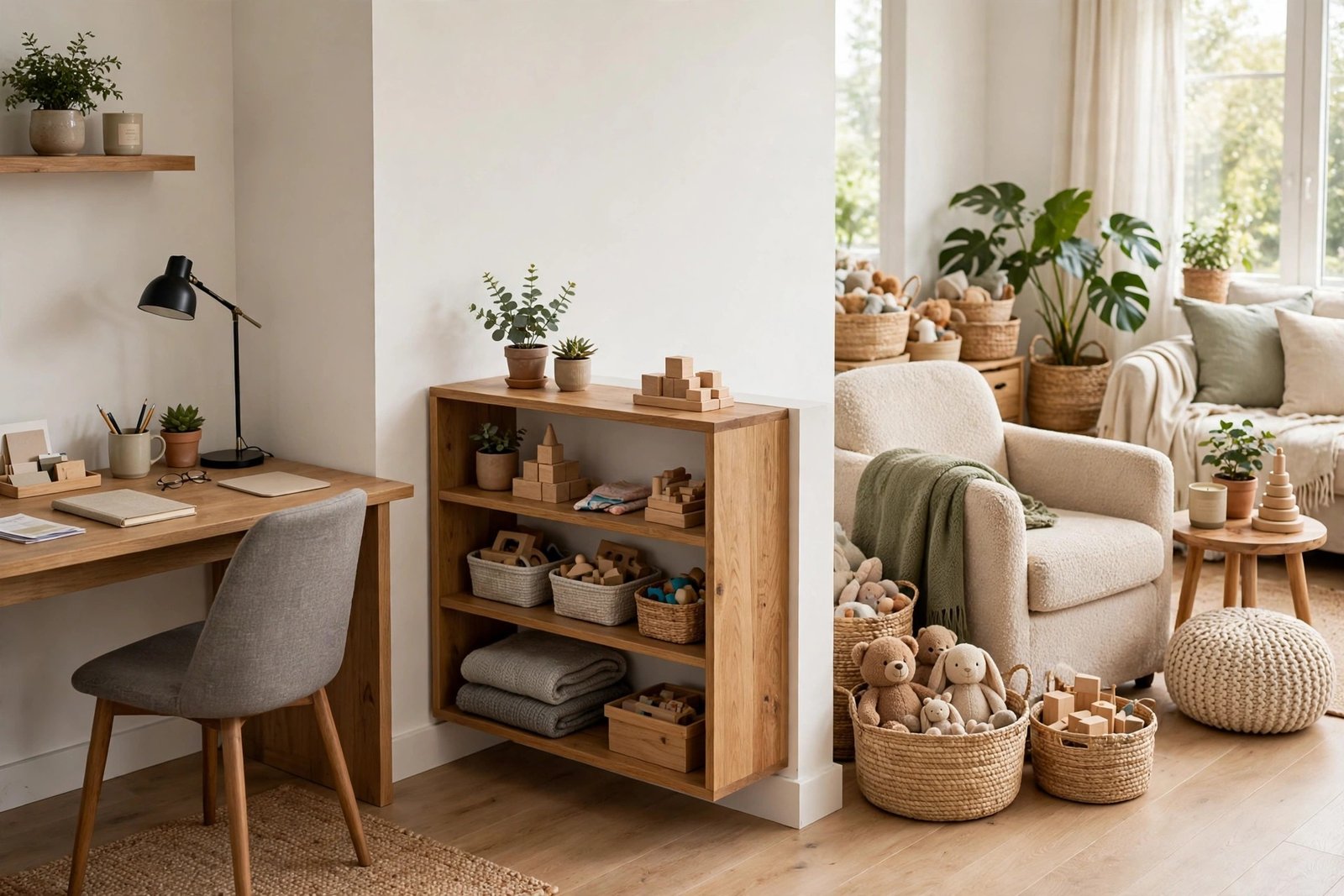
A corner setup that is complete and self-contained survives sharing far better than a desk that borrows from the whole room. Keep everything work needs inside the zone: chair, storage, chargers, stationery, a bin. Each missing item becomes a reason to leave the desk, drift across the room, and lose ten minutes. Our step-by-step guide to a small home office in a corner shows how to fit a full working setup into a compact footprint that leaves the rest of the room genuinely free.
Face matters too. Sitting with your back to the family area, or at right angles to it, protects your screen and your concentration. You will still hear the room, but you will not watch it, and the family will not feel performed at or policed by your gaze all day.
One Signal Everyone Understands
Agree on a single, visible “do not disturb” signal and use it consistently. The best signals are physical: the screen pulled across, the door of the corner closed if there is one, headphones on, or a small sign or coloured card standing on the desk. Young children can learn “when the screen is closed, Dad is in a meeting” far more easily than “be quiet this afternoon”.
Pair the signal with a fair exchange. When the signal is off, be genuinely available: answer the question, admire the drawing, make the drink. Families respect the boundary much more when crossing it at allowed times is met with warmth rather than a sigh. Keep a notepad by the door or at the edge of the zone where people can leave questions for signal-off times; half of all interruptions were never urgent, just afraid of being forgotten.
Noise, Calls, and the Television Question
Sound is the hardest part of a shared room. You cannot ask a family to live silently, and you should not try. Instead, manage the peaks. Schedule your most demanding calls for the room’s quieter times when you can, and give the family fair warning of the ones that cannot move. For ordinary background life, soft furnishings in your corner, a rug, curtains, and a bookshelf between you and the television, take the edge off household noise.
Headphones are a practical tool here, not a statement. They cut incoming noise, signal unavailability, and keep call audio from broadcasting to the room. For the family’s sake, agree on the television arrangement in advance: perhaps it lives at the far end of the room, watched at modest volume, or with its own headphones during your call-heavy hours. Deciding once, calmly, beats negotiating daily.
Remember that distraction is partly a setup problem. If your corner is arranged so the room’s busiest sights and sounds constantly reach you, no agreement will save your focus; the room fixes in our guide to home office distractions and room setup will strengthen any boundary you set.
The End-of-Day Reset
A shared room must change shifts. At the end of work, close the office down properly: laptop shut and stored, papers away, screen or curtain opened, desk chair pushed in. This ten-minute reset returns the room to the family and, just as importantly, returns you to the family. Without it, the desk sits there all evening like a colleague who never leaves, and the room never fully relaxes.
Weekends deserve the same respect in reverse. Keep work closed away on rest days unless you deliberately choose otherwise. The boundary works because it runs both ways: the family protects your work hours, and you protect the family’s room the rest of the time.

Mistakes to Avoid
- Setting up in the middle of the room. A desk in the centre has no edge to defend and turns the whole room into your office, which the family will resent.
- Relying on verbal rules alone. “Please be quiet” fades by Wednesday; a screen, a rug, and a signal keep working without reminders.
- Making the family zone the leftovers. If work takes the best light and space, sharing feels like losing; both zones deserve a good position.
- Never resetting the room in the evening. An open, glowing desk all night teaches everyone that work never really ends here.
- Different rules every day. Boundaries children and partners cannot predict are boundaries nobody can follow; keep them few, visible, and steady.
Frequently Asked Questions
What is the best divider for a shared room?
A low bookcase or storage unit is usually best, because it divides the room, gives the office storage, and does not block light. A folding screen is the most flexible option, and a rug is the simplest: it marks the office territory clearly even without any height.
How do I take calls when children are playing in the same room?
Agree the call times with the family in advance, use headphones, sit close to the microphone, and use your boundary signal so everyone knows a call is live. For the most important calls, arrange them for the room’s quieter times or another space, rather than expecting silence for hours.
Should the desk face the wall or the room?
For shared rooms, facing a wall or corner is usually better. Your screen stays private, the family is out of your direct view, and they do not feel watched. If you must face the room, a screen or bookcase behind your chair still gives the family some shelter from your eye line.
What if the room is too small for a divider?
Use flat boundaries instead: a rug to mark the zone, the desk turned so your back is to the room, and a strong signal habit. Even in a very small room, a marked corner plus a clear signal works far better than an unmarked desk and good intentions.
Conclusion
One room can honestly serve two lives. Draw the boundary with furniture, give work a corner that can look after itself, agree one signal everyone can read at a glance, and reset the room every evening so family life gets its space back. The boundary is not a wall between you and your family; it is what lets both work and home feel at home in the same room.

1 thought on “Home Office and Family Space in One Room: Boundaries That Work”