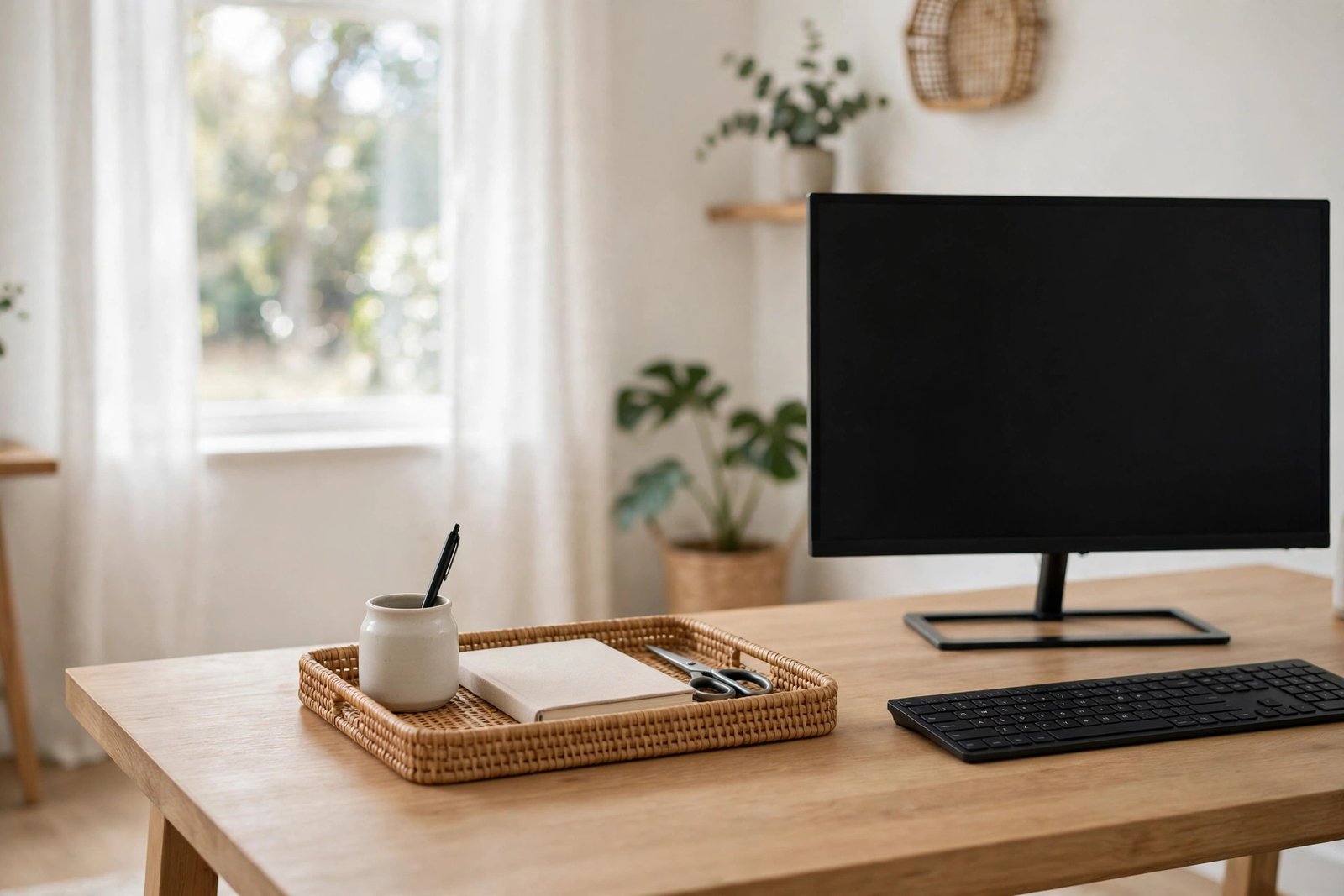
It starts innocently. A pen pot, a stapler, a stack of sticky notes. Then a second pen pot appears, joined by scissors, tape, chargers, notebooks and a small crowd of things that live on the desk because they have nowhere else to live. Before long the desk surface is mostly storage, the actual work space is a shrinking clearing in the middle, and every task begins with pushing supplies aside to make room.
The problem is not that you own too many supplies. It is that supplies spread when they are not contained. Containment is a simple idea: every category of supply gets one defined home with edges, and only a small daily kit is allowed to live loose on the desk. This guide explains how to shrink the desk surface back to a working kit, how to give everything else a proper contained home nearby, and how to stop the slow creep that brings it all back.
Quick Answer
If office supplies are taking over your desk, gather everything into one pile, keep only the items you use daily in a small desk kit, and give every other category one contained home off the surface: a drawer zone, a shelf box or a tray. Work with one of each item out and the spares stored, and refill the kit from storage instead of buying or opening new supplies at the desk.
- Desk surface: one pen, one notebook, and today’s tools only.
- Everything else: one category, one container, one home.
- Spares live in storage, never loose on the desk.
- Refill the desk kit from the spare store, not from a shopping bag.
Step One: Gather Everything and Count Honestly
Start by collecting every loose supply on and around the desk into one place, including the contents of pen pots, the corners of shelves and the top of any piles. The sight of the full pile is useful information. Most people discover duplicates they forgot they owned: several pairs of scissors, many more pens than any person can use, and sticky notes in four places at once.
Now sort the pile by how often each thing is truly used. Daily items are the few tools you touch in almost every work session. Weekly items are used regularly but not every day. Rare items might be needed once a month or less. This frequency sort is the foundation of containment, because each group gets a different kind of home: daily items within arm’s reach, weekly items one step away, rare items in real storage.
Test anything doubtful as you sort. Pens that skip, highlighters that have dried out and chargers for old devices are not supplies, they are clutter pretending to be useful. Let them go now, because a container full of broken tools is no better than a desk full of them.

Step Two: Shrink the Desk to a Daily Kit
The desk surface should hold a kit, not a collection. Choose the small set that covers a normal day: one or two pens that write well, a pencil, an eraser, your current notebook, and the one or two tools your work genuinely uses daily, such as a stapler or a pair of scissors. That kit gets one home on the desk: a single small tray, pot or shallow container, placed where your hand naturally falls.
The size of that container is the system. When the pen pot is full, no more pens join it. A small container enforces the limit quietly and constantly, which is far more effective than willpower. If your daily tools do not fit in one modest tray or pot, the kit is too big, and the least-used item should move to the weekly container.
Position matters too. Keep the kit on your non-writing side or at the back corner of the desk, so the central space in front of you stays clear for the work itself. On a compact desk this matters even more; the layout in our small desk setup guide shows how a clear centre keeps even a one-metre desk feeling workable.
Step Three: One Category, One Container, One Home
Everything that leaves the desk surface still needs a home, and the rule is simple: each category gets exactly one container in exactly one place. Writing spares in one small box. Paper clips, pins and fasteners in one lidded tub. Tape, glue and correction supplies in one place. Cables and chargers in one box. When a category has two homes, both homes become messy, because you never know which one holds the working item.
Choose homes by frequency. Weekly supplies belong in the desk drawer or on the nearest shelf, contained in boxes or drawer zones. If the drawer is part of the plan, it needs its own internal order, which our guide on how to organise a desk drawer covers step by step. Rare supplies, such as the hole punch you use monthly or envelopes for occasional post, can live in a labelled box in a cupboard or on a higher shelf.
Container choice is practical, not decorative. Lidded boxes keep small items from migrating and stack neatly. Open trays suit things you grab often because nothing needs opening. Clear or labelled containers suit deep storage, where you need to identify contents without opening every box. Whatever you choose, keep the style consistent within one storage area; a shelf of matching simple boxes looks calm even when the contents are humble.
Step Four: Control the Spares and the Refill Point
Most desk creep comes from spares. A pen runs out, a fresh pack is opened at the desk, and now nine new pens live in the pot while the spares join the surface. Fix this by creating one refill point: a single storage box or drawer section where all spare supplies live. The desk kit is refilled from that point, one item at a time, and new purchases go straight to the refill point, never onto the desk.
This one change also saves money quietly. When all spares are visible in one place, you stop buying things you already own. A quick look at the refill box before ordering tells you whether you actually need more paper clips or whether three boxes are already waiting.
Set a sensible stock limit per category, based on the space the refill box gives it. When the box is full, the category is full. A new item can only enter when an old one leaves. This is the same one-in, one-out discipline that keeps the wider desk system working, as explained in our article on a storage system that stays tidy.

Step Five: The Two-Minute Reset
Even a good system drifts, because work is messy and supplies get set down where they were used. Build a two-minute reset into the end of the workday or the end of the week: return every loose item to its container, refill the pen pot from the spare box if needed, and clear anything that arrived on the desk without a home. Two minutes works because containment gives every item an obvious destination; without homes, the same reset would take twenty minutes of decisions.
If one category keeps escaping its container, treat that as design feedback, not personal failure. It usually means the container is too small, too far away, or in the wrong place for how you actually work. Move it closer or make it slightly bigger, and the problem usually disappears.
Mistakes to Avoid
- Keeping every supply within arm’s reach. Daily tools belong close; monthly tools close at hand just become clutter with good intentions.
- Using a huge pen pot. A big container invites a big collection. The container size is the limit, so choose a small one.
- Giving a category two homes. Split storage guarantees that the item you need is always in the other place.
- Opening new packs at the desk. New supplies go to the refill point first, or the spares will colonise the surface.
- Storing broken or dried-out tools. A container of supplies that do not work is clutter in a box.
Frequently Asked Questions
How many pens should I keep on my desk?
One or two that write well, plus your pencil and any pen your work specifically needs. All other working pens are spares and belong in the refill box. If you cannot tell which pens work, test them during the sort and keep only the ones that write smoothly.
What if I use lots of different supplies for my job?
Then your daily kit can be a tray instead of a pot, but the rule stays the same: the kit holds one working day of tools in one container, and everything else is contained nearby by category. A craft or design job may need a bigger kit, but it still needs edges.
Where should spare supplies be stored?
In one refill point: a single box or drawer section, close enough to reach in seconds but off the desk surface. One refill point for everything prevents spares from spreading into several half-forgotten stashes.
How do I stop supplies creeping back onto the desk?
Keep the container limits firm, refill only from the spare store, and do a two-minute reset at the end of the day or week. Creep happens one item at a time, and the reset removes it one item at a time before it builds up.
Conclusion
Containment turns a desk covered in supplies back into a workspace with a small, reliable kit. Sort by frequency, shrink the surface to a daily kit in one small container, give every other category one home, and control spares through a single refill point. The desk stays clear not because you tidy harder, but because there is simply nowhere for clutter to spread.
