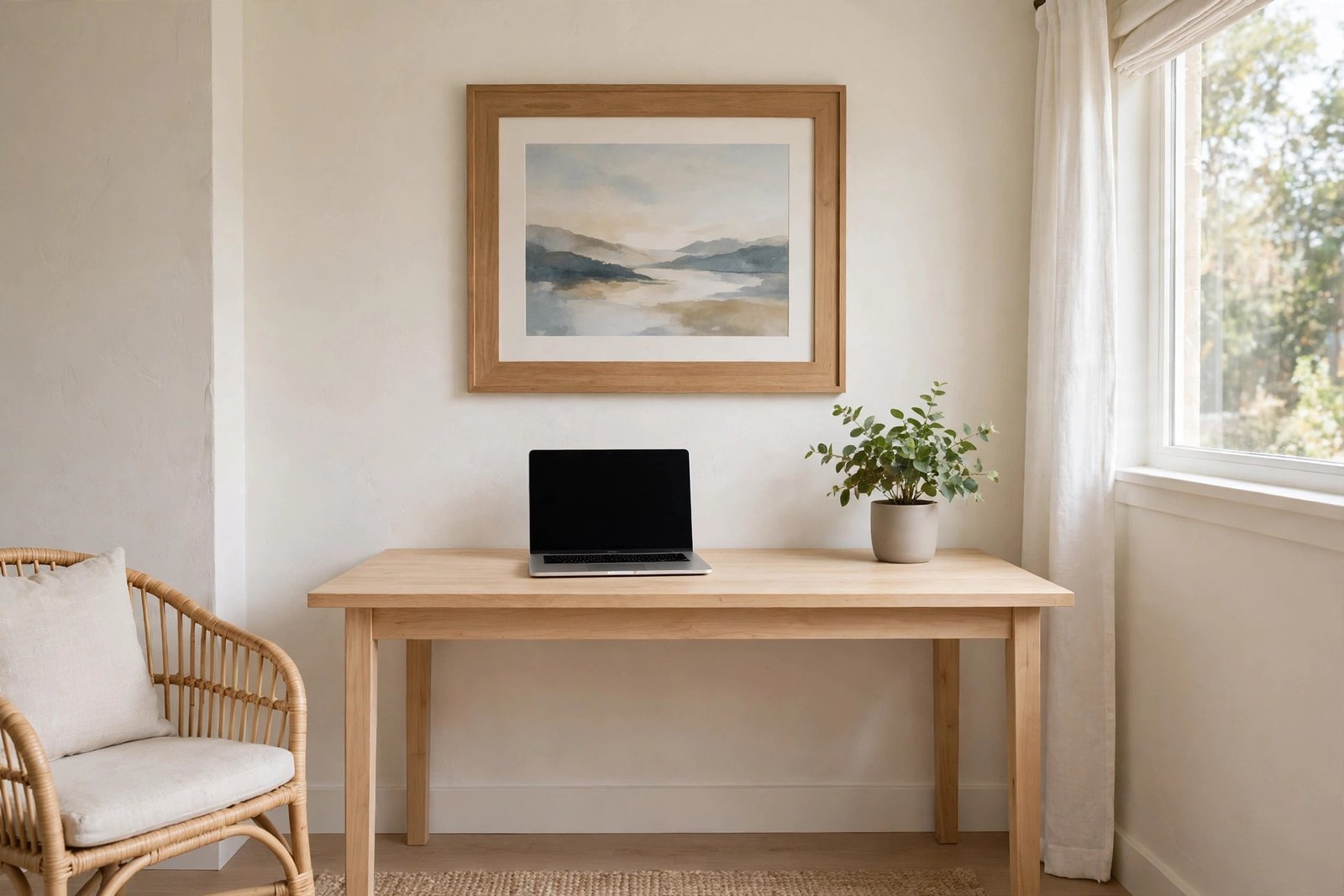
Small offices sit on a knife edge. With nothing in them they feel cold and temporary, like a desk parked in a spare corner. Add a few things too many and the same room feels crowded, restless, and smaller than it is. Most decorating advice ignores this balance, because it is written for rooms with space to spare. In a small office, every object has to justify the room it takes.
The good news is that a small office needs surprisingly little decor to feel finished: one strong focal point, a few pieces chosen in a shared style, and empty space left deliberately empty. This guide shows how to decide what goes in, what stays out, and how to arrange a handful of things so the room feels personal without feeling packed.
Quick Answer
Decorate a small office without overcrowding it by choosing one focal point, limiting decor to a few pieces that share a colour or material, and keeping at least a third of every surface visibly empty. Use the walls instead of the desk, group small items together rather than spreading them out, and follow a one-in, one-out rule so the room cannot slowly fill up again.
- One focal point per room: a picture, a plant grouping, or a styled shelf.
- Fewer, slightly larger pieces look calmer than many small ones.
- Empty space is part of the design, not a gap waiting to be filled.
- When something new comes in, something else goes out.
Start by Choosing One Focal Point
Every calm small room has one place the eye lands first. In an office that is usually the wall you face, or the wall behind you that appears on calls. Decide what lives there and let it be the room’s main statement: one generously sized picture or print, a small group of frames arranged tightly, or a shelf with a plant and a few objects. One clear statement reads as decoration; five small competing ones read as clutter.
Size up rather than down. A single picture that feels slightly too large at first usually settles into the room and makes it feel intentional, while three tiny frames scattered across a wall make it feel fussy. This is the same lesson behind the calm setups in our post on minimalist office ideas: the rooms work because each has one clear idea, repeated quietly, not many ideas at once.
Give Everything a Shared Thread
A handful of objects looks like a collection when they share something, and like a jumble when they do not. The easiest thread is colour: pick two or three colours for decor and repeat them in the cushion, the plant pot, the frame, and the storage boxes. Material works too: wood, black metal, or woven textures repeated three times tie a room together.
This thread is also your shopping filter. A lovely object that matches neither the colours nor the materials will fight the room, however nice it is alone. In a large room you can absorb one rebel piece; in a small office, everything is visible at once, so everything has to get along.
Decorate the Walls, Not the Desk
The desk surface is the most expensive space in a small office, measured in work it can hold. Decor that lives there — ornaments, extra trays, novelty gadgets — taxes you every day. Move decoration upward instead: the walls, a shelf above the desk, and the space around the window can carry pictures, plants, and objects while the desk stays a work surface with at most one small personal item.
If your desk faces a wall, this matters even more, because that wall is your view all day. Our guide to decor fixes for a desk that faces a wall shows how to make that one surface interesting with a board, art, and light without adding a single object to the desk itself.

Group Small Things, Do Not Scatter Them
Small items are where overcrowding sneaks in. One pen pot is fine; a pen pot, a snow globe, three figurines, a candle, a photo frame, and a bowl of stones spread across every surface is a room shouting. The fix is grouping: gather small things into one or two tight arrangements, on a tray, a shelf, or one end of a bookcase, and leave the other surfaces bare.
A tray is the small office’s best friend here. Objects on a tray read as one deliberate arrangement; the same objects spread out read as five separate interruptions. Groups of odd numbers, usually three, look natural, and leaving gaps inside the group keeps it airy.
Leave Breathing Room on Every Surface
Set yourself a simple quota: at least a third of the desk, the shelves, and any side surface stays visibly empty. Empty space is what makes the decorated parts noticeable, and it is also practical: a shelf with gaps can accept a working file or a cup without a reshuffle. When a surface quietly crosses the quota, that is the early warning that the room is filling again.
Floors count too. Keep the floor mostly clear apart from furniture feet, the rug, and perhaps one plant. Floor-standing extras — spare chairs, stacked boxes, exercise gear parked “for now” — shrink the room faster than anything on a shelf.
Choose Pieces That Work Twice
In a small office, the best decor also does a job. A beautiful storage box hides supplies. A plant softens the room and, along with other soft pieces, helps calm echo — the furnishing fixes in our guide to an office that feels noisy and echoey double as decoration in exactly this way. A cushion adds colour and comfort; a good lamp is sculpture and task light in one. When a piece only looks nice and does nothing, it has to be truly loved to earn its place.

The One-In, One-Out Rule
Rooms rarely overcrowd in a single shopping trip; they fill by accretion, one harmless addition at a time. A one-in, one-out rule stops the creep: when a new picture, plant, or object arrives, an existing one leaves, to another room, to storage, or out of the house. The rule keeps the total constant, and it makes each new purchase a genuine decision instead of a reflex.
Review the room twice a year with the same question for every object: would I choose this again today? Decor you have stopped seeing is decor that has stopped working. Removing two or three stale pieces often refreshes a room more than buying anything new.
Mistakes to Avoid
- Decorating every wall. One strong wall and three calm ones feel designed; four busy walls feel like a shop display closing in.
- Choosing many tiny ornaments. Small things multiply visually. Fewer, larger pieces read as calmer and more confident.
- Putting decor on the desk. The desk is for work. Every ornament there is paid for in lost working space, daily.
- Mixing every style you like. Without a shared colour or material thread, even a few objects look like an argument.
- Filling every shelf completely. Full shelves look heavy and leave nowhere for real work items to go.
- Never removing anything. Without one-in, one-out, the room refills by slow accretion no matter how well you start.
Frequently Asked Questions
How many decor pieces does a small office actually need?
Fewer than most people expect: one focal point, two or three supporting pieces that share its colours, and one personal item on or near the desk. Most small offices feel finished at around five to eight decor objects in total, including plants.
What if the room feels empty rather than calm?
Check the focal point first. Emptiness usually means nothing in the room is making a statement, not that there are too few objects. Enlarge or strengthen the one main piece — a bigger picture, a bolder plant — before adding more small things.
Can I still display personal items and photos?
Yes; personal items are what make an office yours. Group them: one small cluster of photos in matching frames on a shelf or wall reads as one warm arrangement, instead of frames spread across every surface competing for attention.
How do I decorate when the office is also a guest room or living room corner?
Choose decor that suits the room’s other life too: pictures, plants, and soft furnishings rather than anything office-branded, and keep work gear in closed storage. The corner then reads as part of the home, decorated once for both uses.
Conclusion
Decorating a small office without overcrowding it comes down to restraint with a system: one focal point, a shared thread of colour or material, decor on the walls instead of the desk, groups instead of scatter, a third of every surface left empty, and one-in, one-out forever. A handful of chosen pieces in a calm room will always beat a crowded room full of lovely things.
