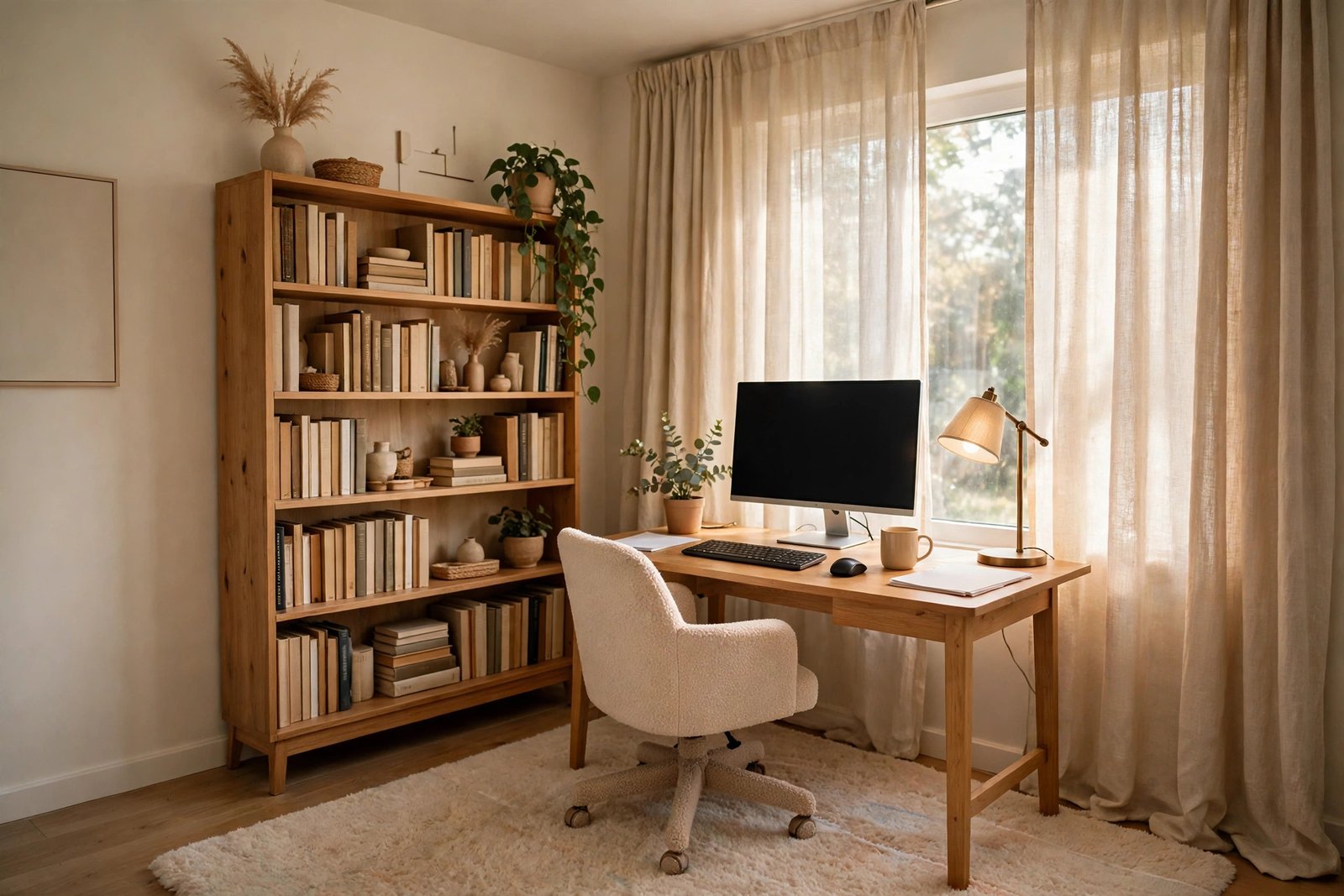
Some home offices look perfect and sound terrible. Every keystroke clicks, your voice bounces back at you on calls, and the room feels oddly like an empty hall. The cause is almost never the room’s size. It is the surfaces: bare floors, hard walls, plain ceilings, and glass all reflect sound instead of absorbing it, so noise builds up and lingers.
The good news is that echo is one of the easiest office problems to soften, and it needs no special equipment. Ordinary soft furnishings — the rug, curtains, cushions and upholstery you might choose for comfort anyway — soak up sound as a side effect. This guide works through the room surface by surface, so you can calm the echo with things that also make the office warmer and more pleasant to sit in.
Quick Answer
If your office feels noisy and echoey, add soft surfaces in this order: a rug on hard floors, full curtains at the window, something soft or textured on the largest bare wall, an upholstered chair and cushions, and a seal or sweep on the door gap. Each soft surface absorbs sound that hard surfaces bounce around. Most small rooms feel calmer after the first two or three changes.
- Think in surfaces: floor, window, walls, furniture, door.
- Soft, thick, and slightly rough materials absorb sound; hard, smooth ones reflect it.
- You do not need to cover everything — breaking up the biggest bare areas works.
- Fix the door gap too, or hallway noise keeps leaking in underneath.
Why Small Offices Echo
Sound behaves like a ball in a hard room: it bounces from wall to floor to ceiling and back, many times before it fades. The more bounces, the longer you hear it, and the room starts to sound echoey and tiring. Modern small offices are full of bouncing surfaces: laminate or wood floors, painted plaster walls, a plain ceiling, a glass monitor, and a desk with a hard top.
Soft materials interrupt the bouncing. Fibres in fabric, padding, and rugs trap some of the sound’s energy each time it reaches them, so it fades faster. Nothing here needs specialist panels or construction. If echo is one of several things making the room hard to work in, our guide to setting up the room to reduce home office distractions covers the wider picture of sightlines, noise, and interruptions together.
The Floor: Start With a Rug
The floor is usually the largest hard surface in the room, and the easiest to change. A rug under the desk and chair area absorbs both the sound of the room and the small noises you make yourself: chair wheels, feet, dropped pens. The thicker the pile, the more it absorbs, and a rug pad underneath adds softness and stops slipping.
Size matters more than style. A rug that covers only a small patch in the middle leaves most of the floor still reflecting. Aim for a rug big enough that your chair stays on it when you roll back, and that reaches toward the walls on at least two sides. If a full rug is not possible, a runner along the desk wall plus a smaller mat under the chair still helps.
The Window: Curtains That Actually Cover
Glass is one of the hardest, most reflective surfaces in any room, and blinds do little to soften it. Full curtains are far better: fabric folds present many small soft surfaces, and the air gap between curtain and glass absorbs more sound still. Choose curtains that cover the whole window and a little beyond, falling below the sill or to the floor.
Heavier fabrics and lined curtains absorb more than thin sheers, but any real curtain is a clear improvement over bare glass or a hard blind. If you rent or already have blinds you like, adding curtains over them is usually allowed and gives you light control and sound softening in one move.

The Walls: Break Up the Biggest Bare Surface
After floor and window, look at your largest uninterrupted wall, especially the one opposite the window or behind your desk. A completely bare painted wall is a sound mirror. You do not need to cover it; you need to interrupt it. A bookcase filled with books is one of the best sound softeners in a home, because books are heavy, soft-edged, and uneven. A fabric wall hanging, a cork board, framed prints with fabric or canvas surfaces, or open shelves with a mix of objects all break up reflections too.
Position counts. Softening the wall you face, and the wall behind you, helps your voice on calls most, because those are the surfaces your voice hits first. This is also where the advice overlaps with making a room feel warmer: the layered, textured approach in our guide to making a small office feel warm without clutter adds exactly the soft surfaces that calm echo, just chosen for looks first.
Furniture and Soft Details
Upholstery quietly does a lot of work. An upholstered chair absorbs more sound than a hard plastic or wooden one, and a cushion, throw, or fabric-covered storage box adds more soft area still. If your office has a spare corner, a soft chair or even a floor cushion creates a pocket of absorption and a second place to sit.
Small details add up: a fabric desk mat softens typing sounds at the source, soft furnishings on shelves break up reflections, and plants soften the room slightly while breaking up flat surfaces visually. None of these is powerful alone; together they finish the job the rug and curtains started.
The Door: Seal the Gap
Echo inside the room is only half the story. The other half is noise arriving from the rest of the house, and its favourite route is the gap under the door. Hold a hand near the bottom of the closed door on a busy evening and you can often feel the draught that carries the sound. A simple brush strip or adhesive door sweep closes most of that gap, is cheap, and can be removed later if you rent.
A heavier door helps if you ever replace one, but the sweep plus a soft hallway runner outside the door already makes a noticeable difference to how much household noise reaches your desk.

How Much Do You Need to Add?
Work in order and stop when the room feels right. Clap once, sharply, in the middle of the room and listen: a hard echoey room answers with a fluttery ring, while a softened room answers with a short, dull thud. Add the rug first, test again, then curtains, then the wall. Most small offices need only two or three of the five surfaces treated. Restraint matters here as much as in the decorating itself, which is why our companion guide to decorating a small office without overcrowding it pairs well with this one: every soft furnishing should earn its place twice, for looks and for sound.
Mistakes to Avoid
- Buying one tiny rug and expecting silence. Coverage is what absorbs sound. A postage-stamp rug under the desk chair barely changes the room.
- Adding hard decor to a hard room. More glass frames, metal shelves, and bare surfaces make the echo worse, however good they look.
- Forgetting the door gap. Treating every surface but leaving a centimetre of open air under the door lets hallway noise pour in.
- Covering every surface at once. An over-softened room feels muffled and oddly heavy. Add in stages and stop when the clap test sounds dull and short.
- Assuming the room is the problem. A loud keyboard, rattling desk items, and a humming fan add noise no furnishing can hide; quiet the sources too.
Frequently Asked Questions
What is the single best fix for an echoey office?
A large, reasonably thick rug over a hard floor. It is the biggest soft surface most rooms can gain in one step, it also softens chair and footstep noise, and it makes the room feel warmer at the same time.
Do I need special acoustic panels?
For a normal home office, no. Panels are one way to add soft surface, but rugs, curtains, books, and upholstery cover far more area for the same effort and suit a home better. Panels make sense mainly for people recording audio all day.
Will soft furnishings help with noise from the rest of the house?
Partly. They calm sound inside your room, but noise arriving from outside mainly comes through the door gap and thin doors. Seal the gap with a door sweep first, then let furnishings handle the echo on your side.
How do I know when I have added enough?
Use the clap test and a normal call. When a sharp clap sounds short and dull instead of ringy, and your voice on calls sounds close and clear rather than bathroom-like, the room is treated enough for everyday work.
Conclusion
An echoey office is a surface problem, and soft furnishings are the fix: a proper rug, real curtains, a broken-up wall, upholstered pieces, and a sealed door gap. Add them in that order, testing as you go, and the room becomes calmer to work in and kinder on calls, using nothing more exotic than fabric, books, and a brush strip.