The first ten minutes of the workday set the tone for the next eight hours, and for many home workers those ten minutes are a small daily disaster. The desk is covered with yesterday’s mug, papers, and charger cables. Your notebook is somewhere under the pile. The mouse is missing, the good pen has wandered off, and by the time you have cleared a space and found everything, the fresh start you were hoping for has already leaked away.
A slow, messy start is rarely a motivation problem. It is a layout problem: a desk where nothing has a fixed home, so every item lands wherever yesterday ended. The fix is a desk layout that resets itself — one where the evening clear-down takes two minutes because every object has exactly one place to go, and the morning begins with a surface that is already ready.
Quick Answer
To end the messy start to the workday, give every daily item a fixed home on or in the desk, keep the work surface almost empty by default, and finish each day with a two-minute reset: rubbish out, papers into one tray, tools back in their spots, tomorrow’s first job placed in the middle. When the desk returns itself to the same ready state every evening, mornings stop being an excavation and start being a beginning.
- Mornings inherit yesterday’s desk. Fix the evening and the morning fixes itself.
- An item with no fixed home will be lost at 9am, every day, guaranteed.
- The work surface should hold today’s job only — everything else lives in storage.
- A two-minute reset beats a heroic weekly tidy, every time.
Why Mornings Inherit Yesterday’s Mess
Look closely at what makes a start feel messy and you will find it is almost never this morning’s fault. The pile on the desk is yesterday’s post, yesterday’s notes, yesterday’s cables. The missing item was put down “just for now” at some point the day before, in a place that was never meant to be its home. A desk without fixed homes does not stay tidy by accident; it drifts, a few items a day, until the drift becomes the system.
This is why a big weekend tidy never lasts. Tidiness imposed on a layout with no homes lasts about two days, because the layout itself keeps producing the mess. The goal is not a tidier you. The goal is a desk where putting things away is the easiest option — easier than dropping them on the surface — so the tidy state is the one the desk naturally returns to.
That means designing the reset before doing it: decide where each daily item lives, make that place close and obvious, and shrink the work surface’s job to one thing at a time. Our guide to a storage system that stays tidy covers the underlying storage design if your desk has deeper problems than a bad morning.
Give Every Daily Item a Fixed Home
Start with the items you touch every day: laptop or keyboard, mouse, notebook, pen, phone and its charger, headphones, water bottle, and the mug. Each one gets one home, and the home should be reachable from your chair or within one step. A home that requires a walk across the room will be skipped on tired days, and skipped homes are how surfaces fill up.
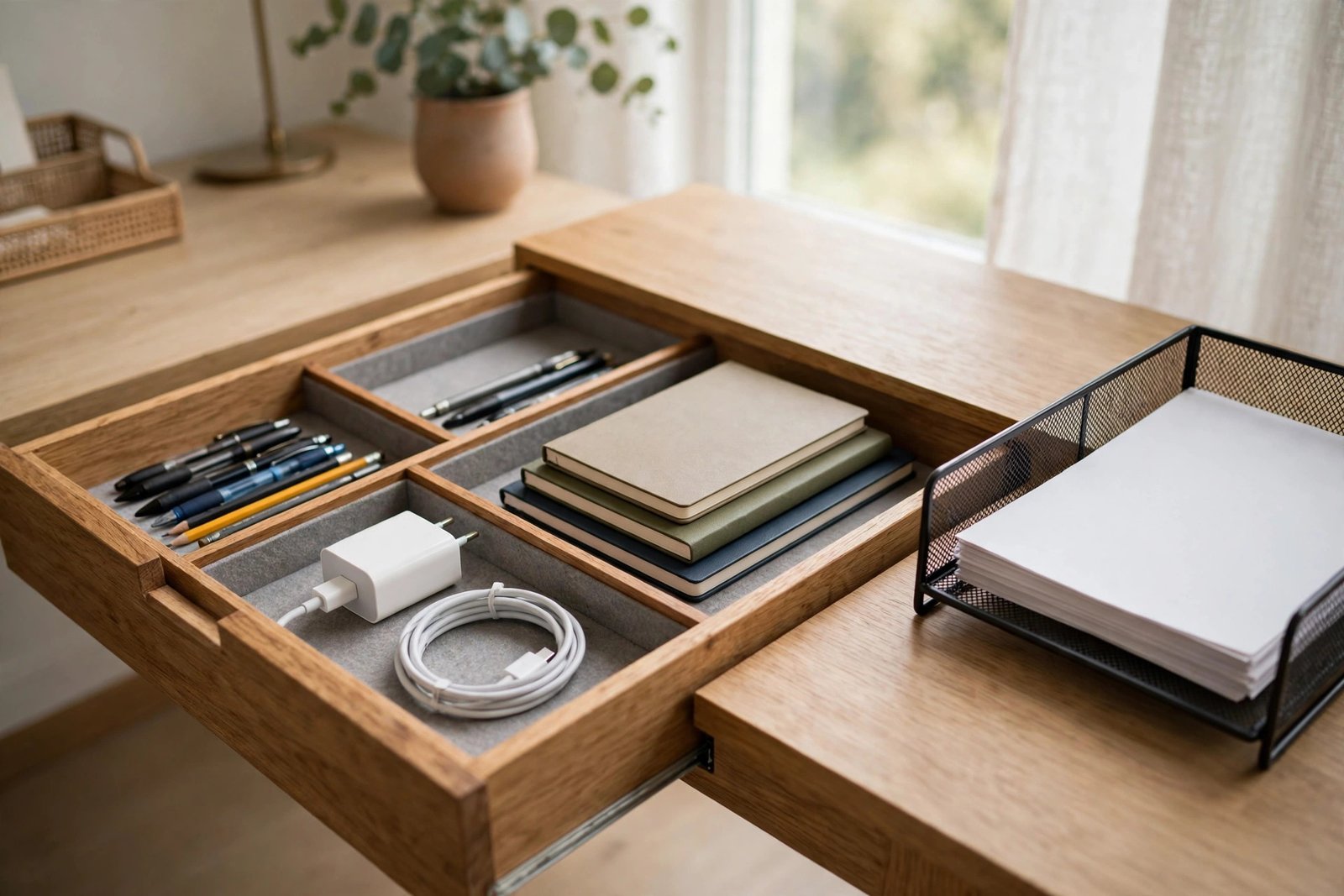
Drawers are the best homes for small tools — pens, chargers, cables, sticky notes — because they close. If your desk has no drawers, a single lidded box or a small desktop organiser does the same job. The rule that makes it work is zoning: one drawer or box section per type of item, so “away” is also “findable”. The method in our guide to label and zone a home office applies just as well inside one desk as across a whole room.
Be honest about orphans. If an item has no sensible home — the spare cable, the old notebook, the gift pen — it does not belong on the desk at all. Give it to a cupboard or let it go. Every orphan you keep on the surface is a small daily tax on your morning.
Keep the Work Surface Almost Empty by Default
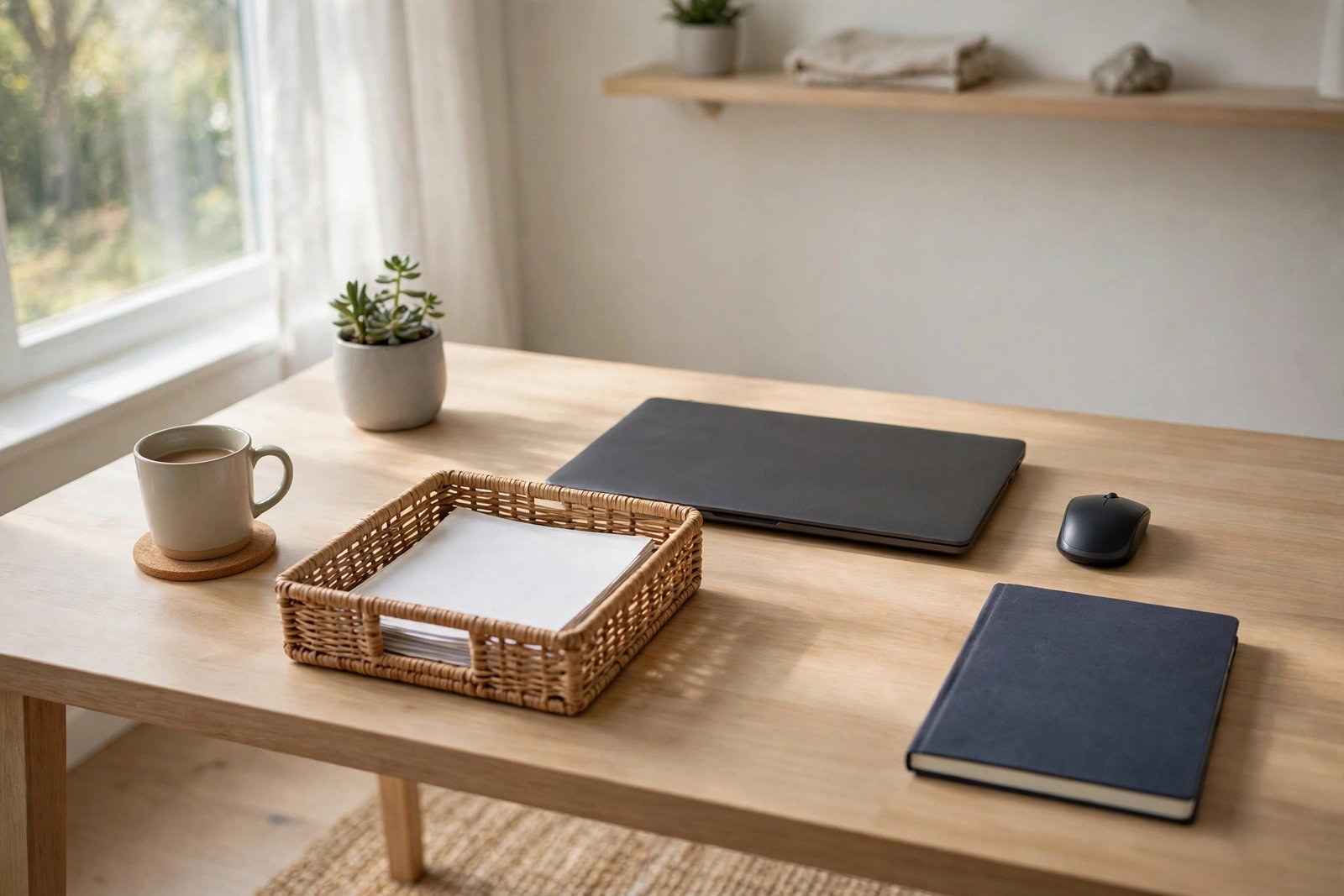
A self-resetting desk has a clear default state: screen, keyboard, mouse, and one active notebook or document — nothing else. That emptiness is not minimalism for its own sake. It is what makes the reset fast, because returning to “almost empty” is a two-minute job, while returning to “reasonably tidy” requires decisions, and decisions are what tired people skip at 6pm.
Paper is the usual invader, so give it one narrow door into the desk: a single in-tray or letter tray. All paper — post, printouts, notes to file — lands there and only there. The tray can hold a small backlog without spreading, and one weekly sort keeps it honest. A desk where paper has one home looks clear even on a busy week, because the mess is contained in a stack instead of spread across every corner.
Drinks deserve a rule too. Yesterday’s mug collection is the classic symbol of the messy start. One mug or bottle at a time, on a coaster in a fixed spot, and it leaves the desk when you do at the day’s end. Small rule, disproportionate effect on how the morning looks.
The Two-Minute Evening Reset
The reset is the engine of the whole system, and it must be short enough to survive your worst day. Two minutes, four moves. First, rubbish and the mug leave the room. Second, loose paper goes into the tray. Third, tools go back to their homes — mouse beside the keyboard, pen in its pot or drawer, headphones on their hook, charger coiled in its spot. Fourth, and most important: place tomorrow’s first task in the middle of the clear desk.
That last move is what turns a tidy desk into a fast start. You sit down to a surface that shows you exactly one thing — the first job — with every tool already in place around it. There is no hunting, no clearing, no decision about where to begin. The workday starts at the work, not at the archaeology.
Anchor the reset to an existing moment: when the computer shuts down, the reset happens. It works best while you are still at the desk, before you leave the room and the day officially ends. If you share the space or pack away daily — as anyone working from the kitchen table must — the reset and the pack-away are the same two minutes, which is exactly why the system suits shared spaces so well.

Set Up the Morning the Night Before
Beyond the first task, a few small preparations remove the remaining friction from the start of the day. Charge what needs charging overnight, in its home, so cables are not hunted at 9am. Lay the notebook open at today’s page with the pen on top. If the first job needs a document or a file from a drawer, pull it out during the reset and put it in the tray’s top position.
Water is worth thinking about in layout terms too. A bottle filled the night before, or a glass placed by the sink if you start the day in the kitchen, saves the small wandering that often turns into phone-checking and drift. None of this takes more than a minute inside the reset. The point is that every decision about “where is it, what first, what do I need” is answered before you sit down.
Within a week, most people notice the change is not really about tidiness. The morning feels calmer because it has no false start in it. You sit, you see the first job, and you begin.
Mistakes to Avoid
- Relying on a weekly big tidy. A layout with no fixed homes re-messes itself within days. Daily two-minute resets on a zoned desk actually hold.
- Giving items homes that are far away or awkward. A charger stored in another room will live on your desk instead. Homes must be within easy reach to be used.
- Letting paper land anywhere. Without one tray as the only paper home, paper spreads across the whole surface and the morning excavation returns.
- Skipping the reset on tired days. The reset matters most on the worst days; two minutes when you least feel like it buys the easiest possible morning.
- Leaving the first task undecided. A clear desk with no visible first job still starts slowly. Place tomorrow’s first task in the middle before you leave.
- Storing daily tools in closed cupboards across the room. Distance defeats habit. Keep daily items in drawers or a box at the desk itself.
Frequently Asked Questions
How long does the evening reset really take once it is a habit?
About two minutes, because there is nothing to decide. Rubbish out, paper in the tray, tools in their homes, first task in the middle. The reset only becomes slow when items lack homes and each one needs a decision — which is why setting up the zones comes first.
What if my desk is very small?
Small desks benefit most. With no room for drift, fixed homes are essential: daily tools in one drawer or box, paper in one slim tray, and the surface kept for the current job only. A small desk with a strict layout resets faster than a big desk with a vague one.
I share my workspace. Can a self-resetting layout still work?
Yes — it works better, because the reset is also the hand-over. Agree on the default state of the surface and each person’s storage box, and the person leaving returns the desk to that state. Shared desks fail when there is no agreed “ready” state, not because they are shared.
What should I do about the backlog already on my desk?
Do one setup session, not a tidy: box everything off the surface, set up the zones and homes, then put back only daily items and current work. File or recycle the rest from the box over the following week. Starting the system from a clean surface is far easier than converting a pile gradually.
Conclusion
A messy start is not a morning problem; it is the visible end of a desk with no fixed homes and no closing routine. Give every daily item one reachable home, let the surface hold only the current job, give paper a single tray, and spend two minutes each evening returning the desk to its ready state — with tomorrow’s first task waiting in the middle. Do that for a week and the workday stops beginning with an excavation. It begins with the work.