
A desk is a piece of furniture most people never question. It arrived flat-packed or was already in the room, so it stays at whatever height it happens to be, and your body quietly adapts around it. If your desk is too high or too low, you pay for that adaptation with raised shoulders, bent wrists, an aching back, or knees pressed against the underside of the desk. The tricky part is that the symptoms rarely point at the desk directly, so people blame their chair, their screen, or themselves.
This guide shows you how to measure whether your desk height fits your body, how to recognise the signs of a desk that is too high or too low, and what to change — including several fixes that do not involve buying a new desk at all. A short note: this article covers furniture setup only. Ongoing or worsening pain in your back, neck, wrists, or shoulders is a reason to talk to a doctor or physiotherapist, whatever your desk measures.
Quick Answer
To tell if your desk is too high or too low, sit in your properly adjusted chair with your feet flat on the floor, then rest your hands on the keyboard. Your elbows should bend at roughly 90 degrees, your shoulders should stay relaxed and down, and your wrists should float straight rather than bending up or down. If your shoulders rise or your wrists bend upward, the desk is too high. If you lean down to reach the surface or your knees hit the underside, it is too low or too shallow. Fix the chair height first, then the desk.
- Elbows at about 90 degrees, forearms roughly level.
- Shoulders relaxed, never lifted toward your ears.
- Wrists straight and floating, not pressed into the desk edge.
- Knees clear of the underside of the desk with room to move.
The Simple Elbow Test
You do not need a tape measure to start. Adjust your chair first so your feet rest flat on the floor and your knees sit level with your hips; if you are unsure how, the steps in our guide to a desk chair that hurts your back walk through it. This order matters, because the chair sets the height of your body and the desk must be judged against that, not the other way around.
Now roll your chair up to the desk and place your hands where you type. Look at your arms honestly. Forearms roughly parallel to the floor, elbows close to your body at about a right angle, shoulders dropped and relaxed: that is a desk at the right height. Any big departure from that picture tells you the desk, the chair, or both need to change.
If you want a number, measure from the floor to the top of the desk surface while you sit correctly. For most adults, a comfortable typing height lands somewhere around 60 to 75 centimetres, but bodies vary a lot. Your elbow test is a better judge than any standard table, because it uses your chair, your legs, and your arms, not an average person.
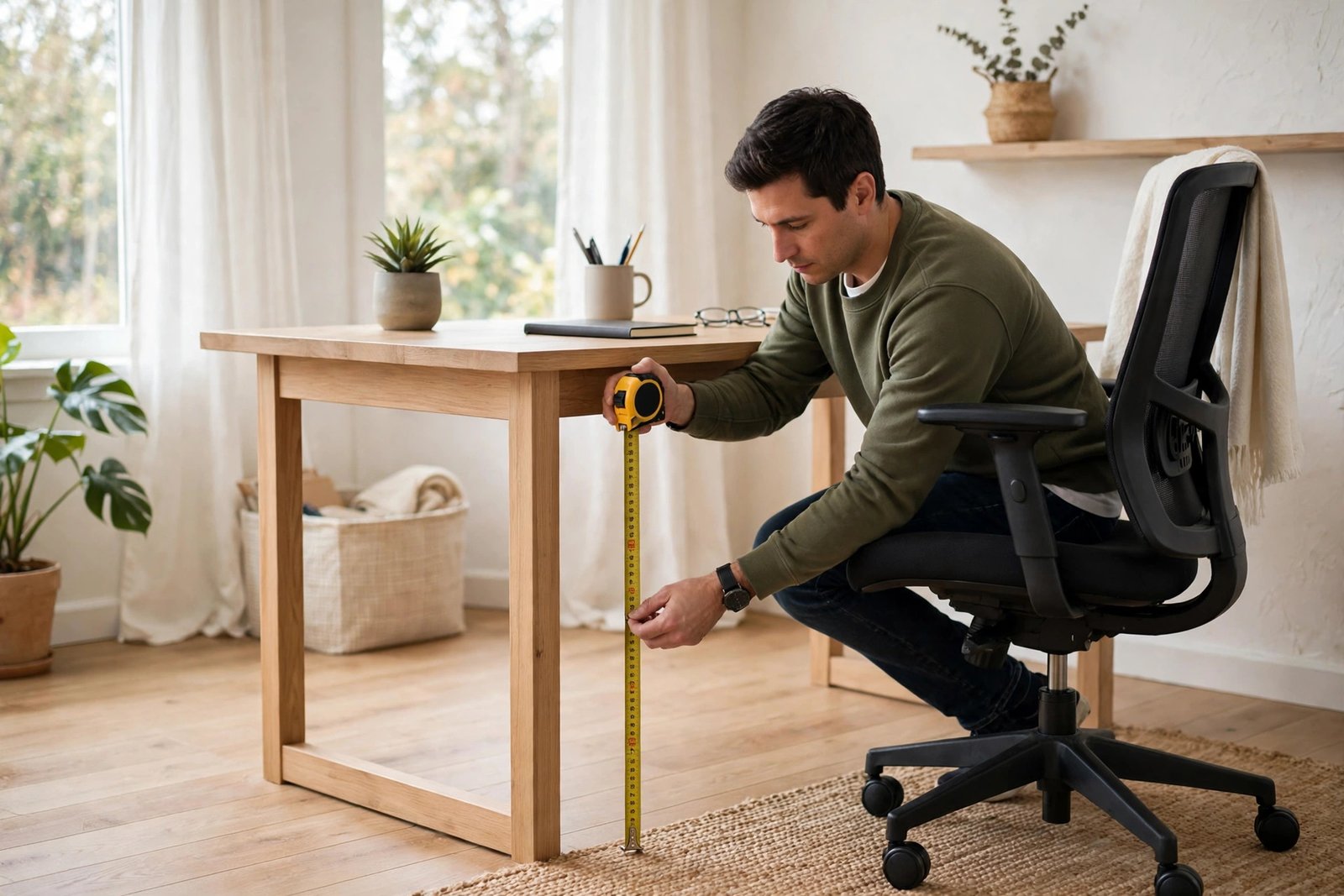
Signs Your Desk Is Too High
A desk that is too high makes you work upward all day. The clearest sign is your shoulders: they creep up toward your ears as you type, and the muscles between your neck and shoulders feel tight by lunchtime. Your wrists bend upward to reach the keyboard, and the heels of your hands press hard into the front edge of the desk. You may also find your elbows winging out to the sides because they cannot rest comfortably close to your body.
Another clue is that your chair ends up raised very high to compensate, leaving your feet dangling or your toes barely touching the floor. A tall desk with a raised chair can feel acceptable for an hour and punishing by the end of the week. If this sounds familiar, do not assume your wrists are the main problem; wrist discomfort from a high desk is common, and our article on wrist pain from typing explains the connection and the fixes in detail.
Signs Your Desk Is Too Low
A desk that is too low creates the opposite set of problems. You lean forward and down toward your work, your back rounds, and your neck bends to look at the keyboard or papers. Your forearms may angle downward from elbow to hand, which bends the wrists in the other direction. If the desk is low because it was designed as a coffee table or a low console, your knees may not fit underneath at all.
Knee space is its own test. Sit at the desk and check three things: your knees clear the underside without touching, your thighs are not pressed up against anything, and you can cross or move your legs a little. Drawers that hang below the surface, thick table tops, and crossbars between the legs all steal this space. A desk can measure at a fine height on top and still be wrong underneath.
Fix One: Adjust What You Already Have
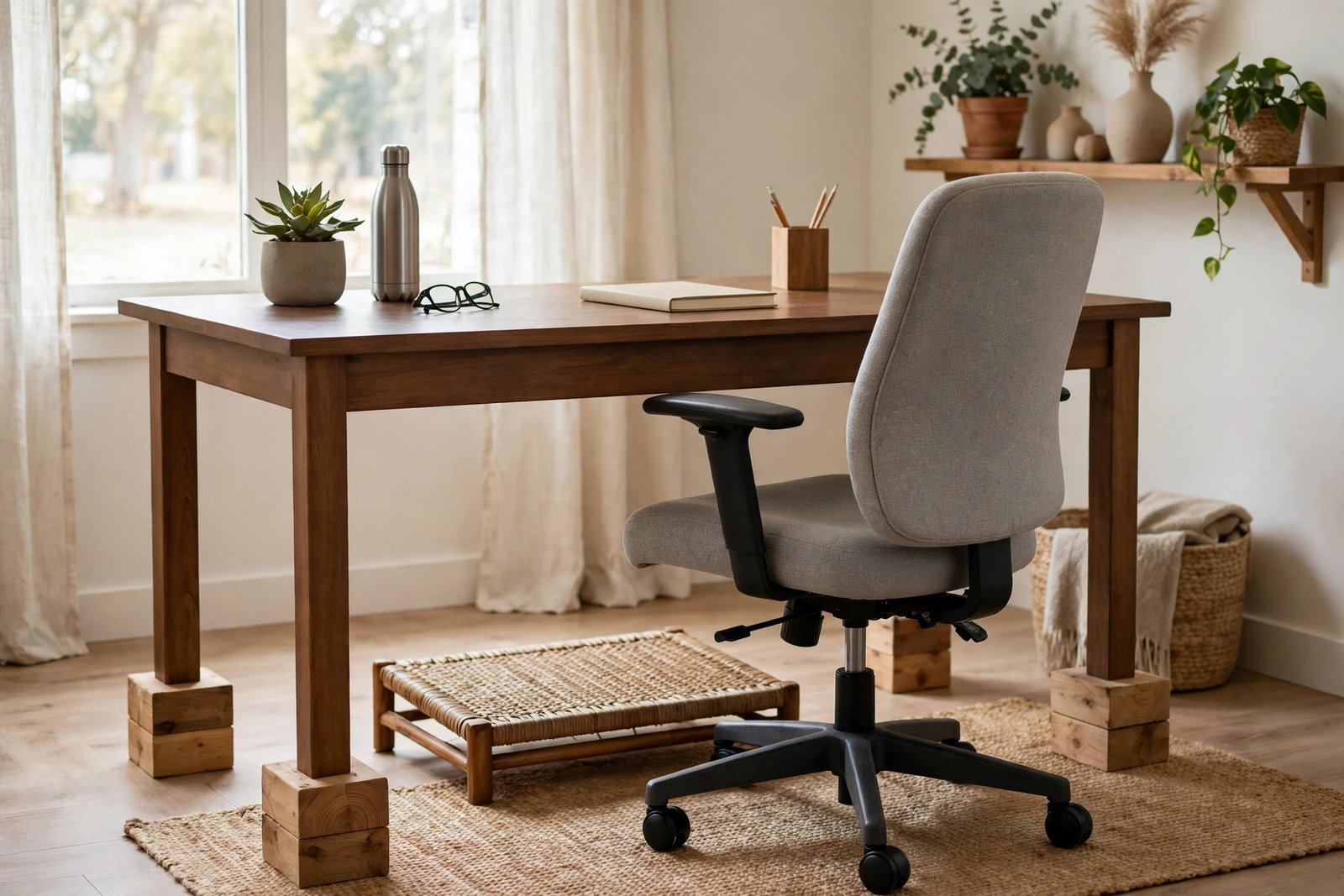
Before replacing anything, work through the free options. Raise or lower your chair to the position that is right for your legs, then see whether the desk still feels wrong. If the desk is a little too high for that correct chair position, add a footrest so you can raise the chair a touch more without dangling your feet. A sturdy box, a stack of hardback books, or a proper footrest all work.
If the desk is slightly too low, furniture risers, taller replacement legs on some models, or blocks under the feet can add the few centimetres you need. Check stability carefully after any change like this; a desk that wobbles at the new height will annoy you more than the old height did. If your workspace is a tight corner rather than a full room, our step-by-step guide to a small home office in a corner shows how height fixes fit into a compact layout.
Fix Two: Change the Typing Surface, Not the Desk
Sometimes the desk’s main surface is fine for writing and screens but wrong for typing. A keyboard tray fitted under the desk lowers just the keyboard and mouse to the right height while the monitor stays up on the surface. This is a classic fix for a desk that is too high, and it also pulls the keyboard closer to your body so you stop reaching.
The reverse exists too. If a desk is slightly low, a thick desk mat will not help, but placing the keyboard on a low stand or using a laptop stand with an external keyboard can raise the typing position a little. These are centimetre-level corrections, which is exactly the scale of most desk height problems. Few people are off by twenty centimetres; most are off by four or five, and small fixes handle that well.
Fix Three: When Replacing the Desk Makes Sense
Replacement is worth it when the desk is far from the right height, too shallow for your knees, or so unstable that fixes feel unsafe. If you shop for a new one, sit at it mentally before you buy: look for a surface height in your tested comfortable range, at least about 60 centimetres of depth so your screen can sit back properly, and open leg room underneath.
Height-adjustable desks solve the problem most completely, because they let you fine-tune the surface to your body and even alternate between sitting and standing through the day. They are not essential, though. A fixed desk at the right height for you, paired with a properly adjusted chair, covers everything your body actually needs. Measure your ideal height from your current setup first, and shop with that number in hand.
Mistakes to Avoid
- Judging the desk before adjusting the chair. The chair sets your body height; the desk is judged against it, never the other way around.
- Copying a standard desk height from the internet. Average numbers ignore your chair, your legs, and your arms. Your elbow test is more accurate.
- Raising the chair and leaving your feet dangling. A footrest solves this; dangling feet quietly undo every other fix.
- Ignoring the space underneath. A correct top height with drawers crushing your knees is still a wrong desk.
- Waiting for pain to force a decision. Shoulder tension and wrist ache are early warnings; small fixes work best before they build up.
Frequently Asked Questions
What is the standard desk height?
Most fixed desks are sold at about 72 to 75 centimetres high. That suits many people but not everyone, which is why the elbow test matters more than the label. If your forearms sit level with relaxed shoulders at your desk, its height is right for you, whatever the number says.
Should I change my chair or my desk first?
Always set the chair first, for your feet and knees. Then judge the desk against your arms in that correct sitting position. If the desk fails the test, adjust or replace the desk, or add a footrest or keyboard tray to bridge the gap.
Can a desk that is too high cause wrist pain?
It can contribute, because a high surface bends your wrists upward and presses them into the desk edge. Lowering the typing surface or using a keyboard tray often eases that strain. If wrist pain is ongoing or worsening, get it checked by a doctor or physiotherapist rather than relying on furniture alone.
How much knee space do I need under a desk?
Enough that your knees and thighs never touch the underside while you sit and shift normally, with room to stretch your legs forward a little. If hanging drawers or a crossbar block that space, moving storage elsewhere can fix a desk that is otherwise fine.
Conclusion
Whether your desk is too high or too low shows up in your body long before it shows up on a tape measure: raised shoulders, bent wrists, a rounded back, or trapped knees. Set your chair correctly, run the elbow test, and then fix the mismatch with the smallest change that works, from a footrest or risers to a keyboard tray. Only a desk that is far off the mark or leaves no room for your legs truly needs replacing — and by then, you will know your own right height to shop for.
3 thoughts on “Desk Is Too High or Too Low: How to Tell and What to Change”