
You sit down at your desk, scoot your chair in, and your feet swing above the floor. Maybe your toes just brush the ground, or maybe you hook your ankles around the chair legs or rest your feet on the wheels to feel stable. It seems like a small thing, but unsupported feet quietly change how your whole body sits. You slide forward in the seat, the front edge of the chair presses into the back of your thighs, and by the afternoon your legs feel restless and your lower back feels tired.
The good news is that this is one of the easiest desk problems to fix. You usually do not need a new chair or a new desk. You need to find out why your feet are dangling, and then give them something solid to rest on.
Quick Answer
If your feet do not reach the floor at your desk, first check whether your chair is raised too high because your desk is too high. If the heights cannot be lowered, support your whole foot on a stable footrest, a sturdy box, or a low stool, so your feet rest flat with your knees roughly level with your hips or a little lower. Keep the area under your desk clear so your feet and the footrest have room.
- Find the cause first: a high desk, a high seat, or a deep seat.
- Support the whole foot, not just the toes.
- Aim for knees about level with your hips, or slightly lower.
- Keep the foot space under your desk free of clutter.
Why Your Feet Are Dangling in the First Place
Feet rarely dangle for no reason. Most of the time, something else in the setup pushed your chair upward. The most common cause is a desk that sits too high: you raise your chair so your arms can reach the keyboard comfortably, and your feet pay the price by leaving the floor. Our guide on a desk that is too high or too low explains how to check your desk height and what to change first, which is worth reading before you buy anything.
The second cause is the chair itself. Some chairs simply do not go low enough for shorter legs, and some dining chairs and stools used as desk chairs are far taller than an office chair. The third cause is seat depth: if the seat is deep and you sit back properly against the backrest, your feet may not reach the floor even at the chair’s lowest setting.
Try this quick test. Sit back in your chair with your back supported and your feet where they naturally land. If only your toes touch, or nothing touches at all, your feet need support. If your feet rest flat but the front edge of the seat presses hard into your thighs, your seat is probably a little too high or too deep as well.
Step One: Adjust What You Already Have
Before adding anything, lower your chair as far as it goes while keeping your arms comfortable at the desk. Many people raise their chair to suit the desk and never check whether a slightly lower seat still lets them type comfortably, especially if the desk is only a little high. Small changes matter here: even a couple of centimetres can be the difference between dangling and resting.
If your chair has adjustable seat depth or a sliding seat, use it. A shallower seat lets you sit back against the backrest without the edge pushing into the back of your knees, and it brings the floor closer to your feet. Our companion guide on chair adjustments to try before buying new covers seat height, depth and backrest settings in detail, and several of those same adjustments help with dangling feet.
If your chair is fully lowered, your desk height is reasonable, and your feet still swing, the furniture is not going to change any further. That is the moment to add support under your feet instead.
Step Two: Give Your Feet a Proper Rest
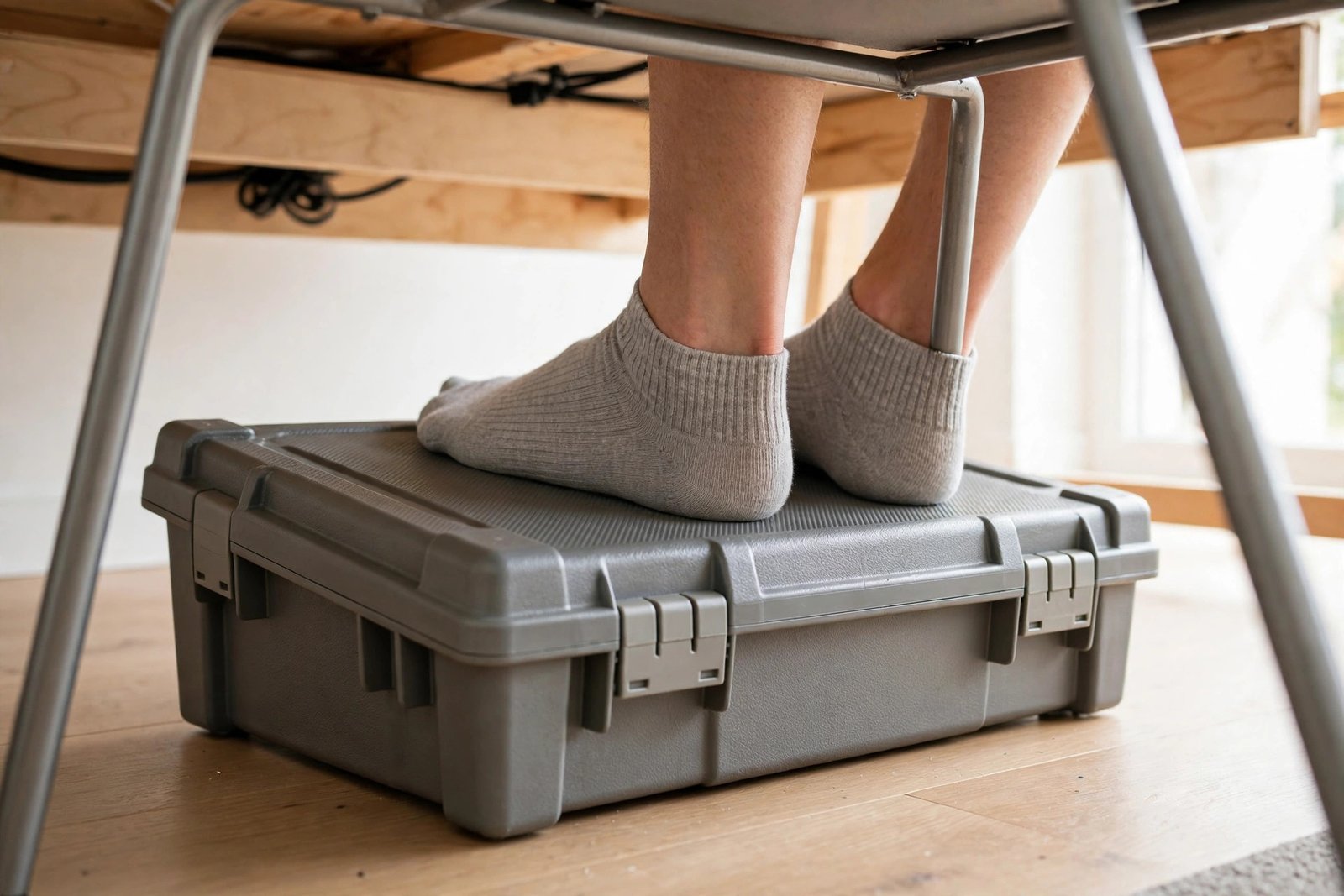
A footrest is the standard answer, but it does not have to be a purpose-built product. Anything stable, wide enough for both feet, and the right height will do the job. Good household options include a sturdy storage box, a low step stool, a thick stack of large books tied together or kept in a box, or a ream of paper still in its wrapping. What matters is that it does not slide, tip, or roll away when you push against it lightly.
Place the rest so your whole foot sits on it, heel to toe, with your knees roughly level with your hips or just a touch lower. A slight tilt, with your heels a little lower than your toes, feels natural to many people, but a flat surface works well too. You should be able to shift your feet around on it during the day, because a supported foot that can still move is better than a foot locked in one spot.
Check the height by how your legs feel after twenty minutes. If the front of your thighs feels pressed or your knees are clearly higher than your hips, the rest is too tall. If you are reaching down with pointed toes, it is too short. Adjust with one book more or less until your legs simply forget about your feet, which is the real goal.
Step Three: Clear the Space Under Your Desk
A footrest needs room, and the space under many desks is already full. Power strips, charger bricks, a computer tower, bags and spare shoes all compete for the same few square feet as your feet. When the space is crowded, your feet end up wherever they fit, which is rarely the right place.
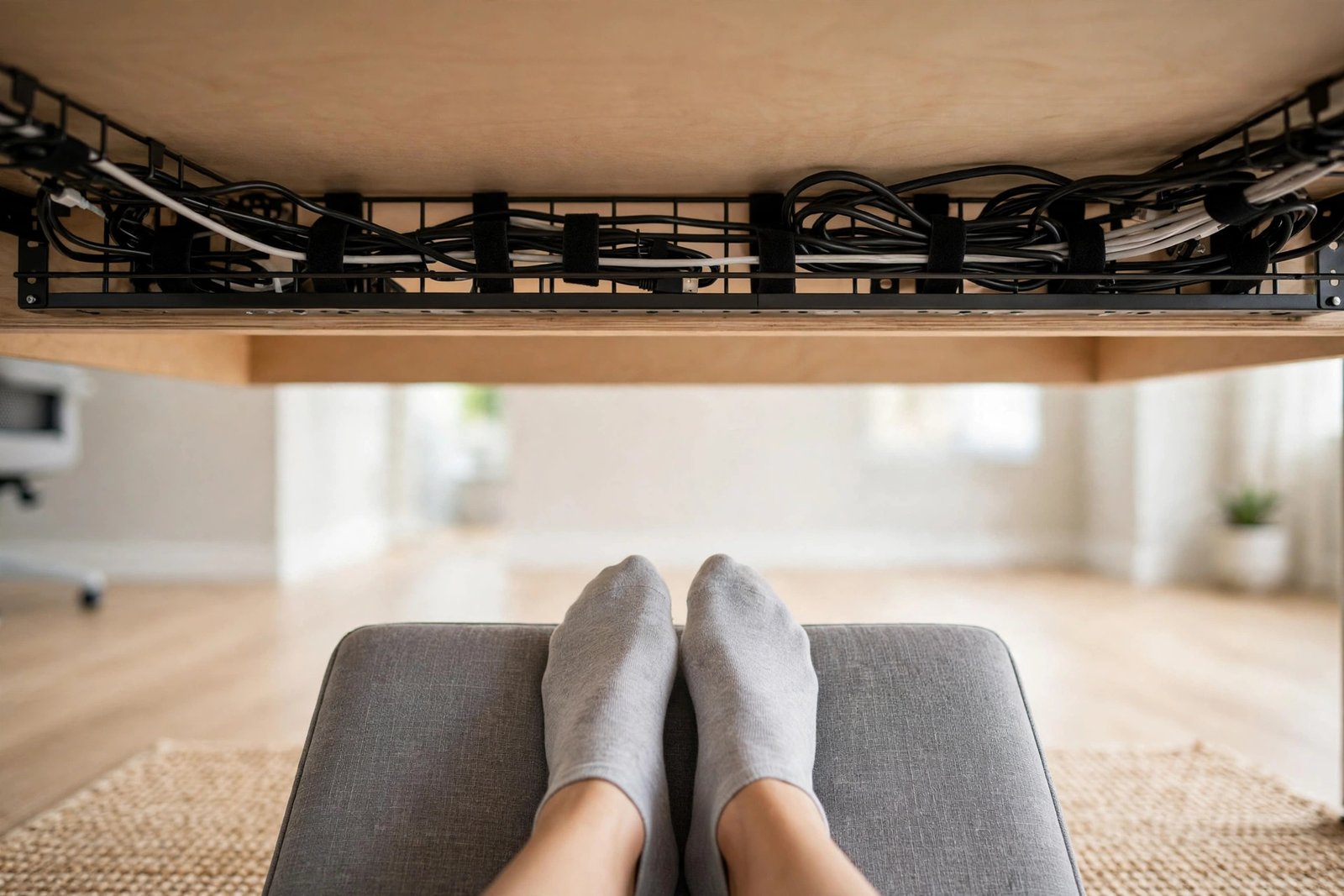
Move everything that does not need to be at your feet. Chargers and cables can be gathered into a tray or box mounted under the desk or placed along the back edge of the floor space, leaving the middle open for your feet and footrest. Our guide to hiding and organising the cords under your desk shows a simple way to do this, and it makes the footrest far more comfortable because your heels stop catching on cables.
Everyday Habits That Help
Change foot position through the day
Even with perfect support, sitting completely still is not the aim. Shift your feet forward and back on the rest, stretch one leg out for a while, then the other. These small movements keep your legs comfortable during long sessions.
Stand up on a schedule
If your feet and legs often feel restless or heavy by mid-afternoon, short standing breaks help more than any single adjustment. Stand while you read, take calls walking around the room, and let your legs fully straighten several times a day.
Do not perch on your feet
Sitting on one foot, tucking both feet up on the chair, or balancing on the chair’s wheel base might feel cosy for ten minutes, but these positions twist your hips and press on your legs. Use them as a brief change of position if you like, not as your default way of sitting.
One calm note: if you regularly notice tingling, numbness, or pins and needles in your legs or feet that does not fade quickly when you change position, or if leg pain keeps returning, it is worth talking to a doctor or physiotherapist rather than only adjusting furniture.
Mistakes to Avoid
- Resting only your toes on the floor. Pointed toes and a raised heel leave your calves working all day and still leave your thighs unsupported.
- Using something that rolls or slides. A ball, a wheeled stool or a loose box turns your footrest into a fidget that steals your balance.
- Making the footrest too high. A rest that pushes your knees well above your hips tilts your pelvis and can make your lower back ache.
- Lowering your chair until your shoulders hunch. Feet on the floor are not a win if your arms now reach up to the desk; fix the desk or support the feet instead.
- Hooking your feet on the chair base all day. It pulls you forward in the seat and leaves the front edge of the chair pressing into your thighs.
Frequently Asked Questions
Is it actually a problem if my feet do not touch the floor?
For short periods, it is harmless. For a full workday, unsupported feet usually mean pressure under your thighs, a tendency to slide forward, and less stability for your back. Supporting your feet is a simple fix that makes the rest of your chair setup work as it should.
What can I use as a footrest if I do not own one?
Use anything stable and the right height: a sturdy box, a low step stool, a wrapped ream of paper, or a stack of large books kept in a box so they do not slide apart. Test it for a day before deciding you need to buy a purpose-built footrest.
How high should my footrest be?
High enough that your whole foot rests on it with your knees roughly level with your hips or slightly lower, and your thighs resting without pressure at the front edge of the seat. If your knees are pushed up high or you are reaching down with your toes, adjust the height.
Should my feet be flat or angled on the rest?
Either is fine. Many people find a slight angle, heels a little lower than toes, feels natural, but a flat rest works just as well. The important parts are that the whole foot is supported, the rest does not move, and you can change position easily.
Conclusion
Dangling feet are a signal, not a life sentence. Check whether a high desk pushed your chair up, use the adjustments your chair already has, and then give your feet a stable, correctly sized rest with clear space around it. When your feet are supported, you stop sliding forward, your legs relax, and the rest of your desk setup can finally do its job.

1 thought on “Feet Do Not Reach the Floor at Your Desk: Simple Fixes”