Every paper pile starts innocently. A letter you need to answer. A form to fill in later. Notes from a call. Printouts you might need again. Each sheet lands on the desk “for now”, and within a few weeks the pile has become a landscape feature: you work around it, stack on it, and occasionally excavate it when something goes missing. Paper piles are not really a storage problem. They are what happens when paper arrives with no rule for what happens next.
The fix is a small routine, not a filing cabinet the size of a wardrobe. This guide sets up a simple system: one landing tray for everything incoming, a two-minute daily sort, a short list of file categories, and a fifteen-minute weekly filing session that keeps the pile from ever forming. Simple enough to survive busy weeks, which is exactly when piles usually grow.
Quick Answer
To stop paper piles on your desk from growing, give all incoming paper one home: a single tray. Each day, spend two minutes sorting the tray into act, file or recycle. File into a few broad categories only, such as current projects, bills and admin, and reference. Once a week, spend fifteen minutes filing what has collected and clearing anything that no longer needs keeping. Paper that never enters the tray system never becomes a pile.
- One tray for all incoming paper; no second landing spots allowed.
- Decide on every sheet quickly: act on it, file it, or let it go.
- Few, broad file categories beat many precise ones you will not maintain.
- A fixed weekly filing slot keeps the tray from becoming the next pile.
Why Paper Piles Grow
A pile grows at the exact moment a sheet of paper reaches your desk and the decision about it gets postponed. The sheet itself is harmless. The problem is the sentence that comes with it: “I’ll deal with that later.” Later has no place in it, so the sheet waits on the surface, and the next sheet waits on top of it.
Three habits feed the growth. First, paper lands in several places, on the desk, beside the keyboard, on a shelf, so no single spot ever gets processed. Second, there is no recycling or shredding bin within reach, so even obvious junk mail joins the pile “for now”. Third, filing feels like a big task because the categories are complicated, so filing is postponed, and postponed filing is simply a pile with better intentions. The routine below removes all three causes.
Step One: One Tray, One Rule
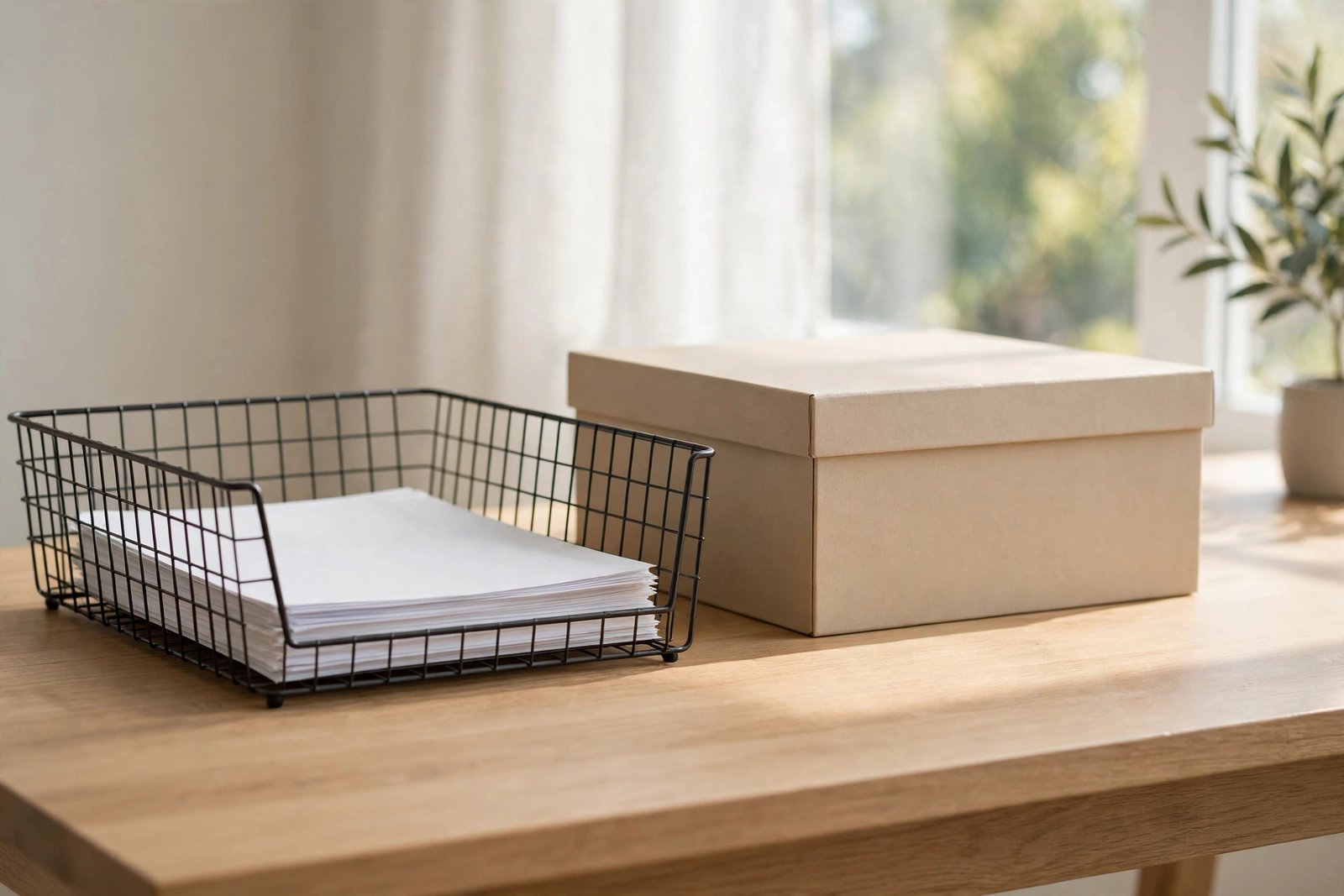
Put a single tray, letter box or shallow basket on your desk or on the nearest surface, and make it the only legal landing place for paper. Post, printouts, notes handed to you, forms, receipts to keep: everything goes in the tray the moment it reaches the office. The rule for everyone in the house is the same. If it is paper and it is for you, it goes in the tray.
This sounds too simple to matter, but it changes everything. Instead of five scattered stacks, you now have one honest queue. You always know where a missing document is likely to be. And because the tray has edges and a small capacity, it complains visibly when it is neglected, unlike a pile, which just grows silently. This one-home principle is the same idea behind a wider desk storage system that stays tidy: nothing in the office is allowed to be homeless.
Step Two: The Two-Minute Daily Sort
Once a day, ideally at the end of work, take the tray and sort every sheet into one of three outcomes.
- Act: it needs a reply, a payment, a signature or a phone call. It stays in the tray as your visible to-do list, or moves to a clearly marked action folder if the tray holds too much.
- File: nothing to do, but it must be kept. It goes straight into the right file in the weekly filing step below, or into a single “to file” folder until then.
- Let go: recycle it, or shred it first if it carries personal details. This is where most of the tray’s contents belong; be ruthless.
Two minutes is enough because the daily pile is small. The tray should end most days holding only genuine actions and a slim layer of to-file paper. If the sort regularly takes longer, paper is entering the office faster than it should, and the next step matters more.

Step Three: Few, Broad File Categories
Filing systems fail when they are too clever. Twenty precisely named folders mean a decision for every sheet, and decisions are what create piles. Use a handful of broad categories instead. Most home offices run well on five or six:
- Current projects: one folder per active project, cleared when the project ends.
- Bills and household admin: statements, contracts and official letters you must keep.
- Work admin: employment, tax and business paperwork, kept by year.
- Personal documents: certificates, warranties and important records.
- Reference: anything you keep only to look at again, reviewed once or twice a year.
Store the files in one box, one drawer or one small set of folders in a single place, close enough to the desk that filing never becomes a trip. In a workspace short on furniture, a single lidded box on a shelf does the whole job; the ideas for a small office with no storage show how much one well-chosen container can hold.
Step Four: The Fifteen-Minute Weekly Filing Session
Pick one fixed slot each week, such as Friday afternoon or Monday morning, and spend fifteen minutes filing. Empty the to-file folder into the categories. Move finished project folders out of the active set. Take one handful of old paper from the reference file and honestly check whether it still deserves its place. Set a repeating reminder if you need one; the routine survives on being scheduled, not on being remembered.
Fifteen minutes of filing a week sounds like a small thing, but it is the engine of the whole system. The daily sort keeps the tray honest, and the weekly session keeps the files honest. Together they mean no sheet of paper in your office is ever more than a few days away from its proper home.
Step Five: Reduce the Paper Coming In
The cheapest sheet to file is the one that never arrives. Where an account or service offers a digital statement instead of a posted one, switch, and save the digital copy into the same category names on your computer so both worlds match. Print only what you will genuinely work on at the desk, and print double-sided or not at all for drafts. Keep a small recycling bin and a shredder or shredding pile within reach of the desk so junk can leave the office the day it arrives, rather than joining the tray. A calmer, less cluttered desk philosophy, like the one behind these minimalist office ideas, starts with fewer things entering the room at all.

Mistakes to Avoid
- Several landing spots for paper. The moment paper can land anywhere, it lands everywhere, and no spot ever gets processed.
- Too many file categories. A system that needs a decision for every sheet will be abandoned within a month.
- Filing as a monthly event. A month of paper is a daunting pile; a week of paper is fifteen calm minutes.
- Keeping paper “just in case”. Most kept-just-in-case paper is never looked at again. Keep what has a clear reason.
- No bin within reach. If recycling means a walk, junk paper joins the tray and stays there.
- Letting the action tray become storage. Actions that are done must leave the tray the same day, or the tray quietly turns back into a pile.
Frequently Asked Questions
What should I do with a huge existing pile?
Sort it in one sitting with the same three outcomes: act, file, let go. Work top to bottom, and expect most of it to be recyclable, because piles mostly contain paper whose moment has already passed. Once the surface is clear, start the tray system the same day so the pile cannot reform.
Do I need a filing cabinet?
No. One storage box, one deep drawer or a small set of folders covers most home offices. The routine matters, not the furniture. Only consider a cabinet if your work generates large volumes of paper that must be kept for years.
How long should I keep bills and statements?
Keep what you need for warranties, disputes and tax purposes, and let the rest go once you have a digital copy or the matter is closed. Rules differ by country and situation, so when in doubt keep official and tax-related paper longer rather than shorter, clearly labelled by year.
What about notes and printouts I make myself?
They follow the same rule. Working notes go in the tray or the current project folder at the end of the day, never left loose “for tomorrow”. When the project or task ends, recycle drafts and keep only the final version you actually need.
Conclusion
Paper piles are a missing routine, not a missing cabinet. One tray that catches everything, a two-minute daily sort into act, file or let go, a few broad categories, and fifteen minutes of filing once a week: that is the whole system. It takes less time than one frustrated search through a pile, and it returns your full desk surface to the work it was meant for.

2 thoughts on “Paper Piles Keep Growing on Your Desk: A Simple Filing Routine”