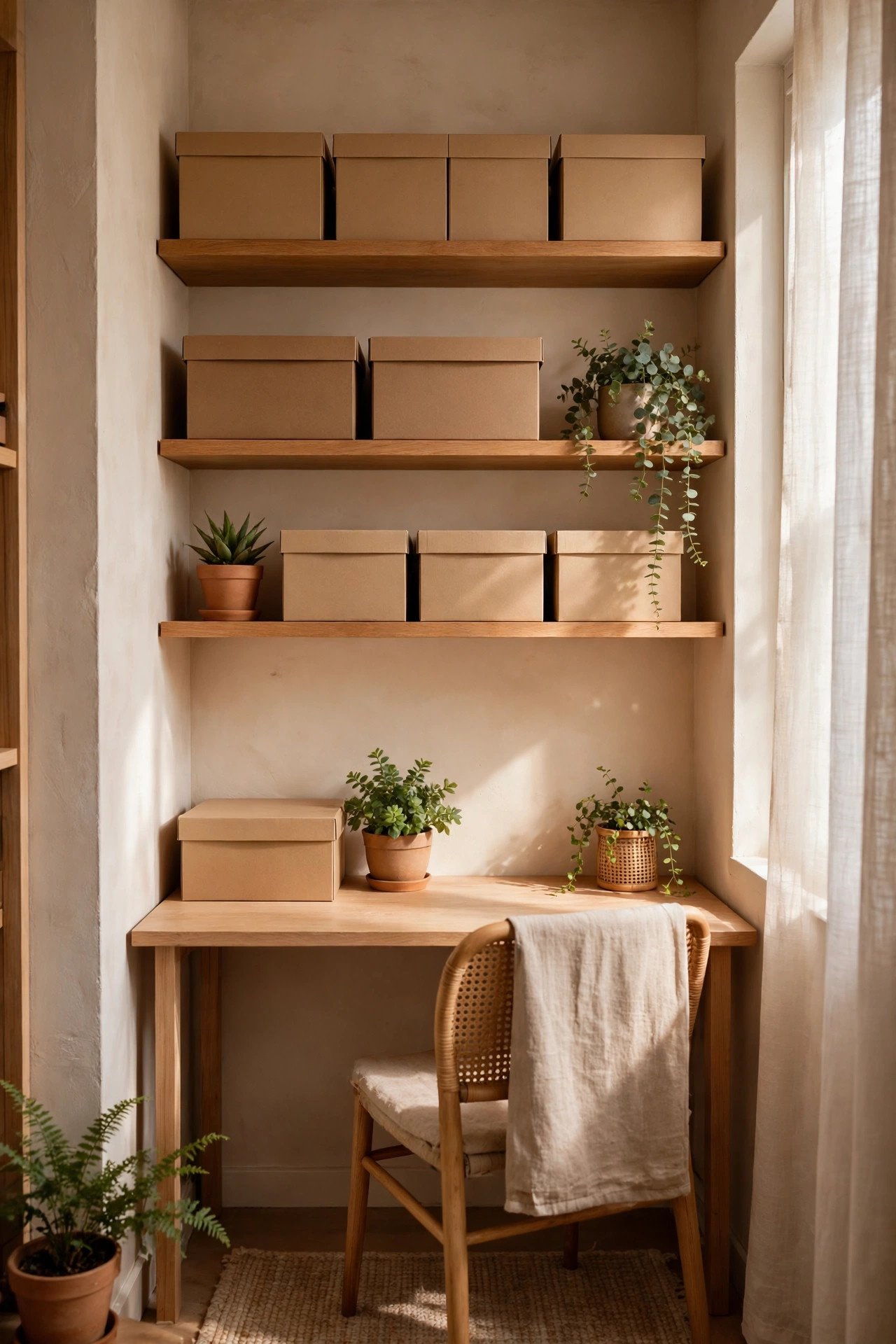
Some home offices come with cupboards and drawers. Yours came with four walls and a floor. No built-in cupboard, no storage wall, maybe no room for a filing cabinet even if you wanted one. So everything migrates to the desk and the floor: boxes in the corner, supplies in carrier bags, cables and paperwork spreading from the one surface you actually need for work. A room like this does not need more square metres. It needs storage that is added deliberately, in places you are currently not using at all.
This guide walks through where storage can hide in a small office that has none: on the walls, above the desk, under it, behind the door and inside the furniture itself. The goal is a home for every category of thing you own, achieved with a few well-chosen pieces rather than a room full of new furniture.
Quick Answer
In a small office with no storage, create it in this order: shelves and wall-mounted holders on the wall above and beside the desk, a drawer unit or boxes under the desk, closed boxes or a bookcase for bulkier items, and hooks or a slim rack behind the door. Keep daily items within arm’s reach of the chair, weekly items on the higher and lower shelves, and rarely used items in labelled closed boxes. Closed storage keeps a small room looking calm.
- The walls are your biggest unused storage area; start there.
- Under the desk fits a drawer unit, boxes and the cable zone.
- Closed boxes keep a small room visually calm; open piles do the opposite.
- Every category of item needs a named home, or it will live on the desk.
Think in Zones, Not Furniture
Before buying anything, list what actually needs storing. Most small offices hold the same categories: paper and files, stationery and small supplies, cables and chargers, a printer or other device, books and reference material, and personal things like a bag and a jacket. Counting the categories honestly stops two mistakes: buying storage for things you do not own, and forgetting the category, usually paper, that causes the most mess.
Then match categories to the three reach zones of the room. Daily items live within arm’s reach of your chair. Weekly items go on the far shelf, the bottom box or the top of the bookcase. Rarely used items can go high, low or even out of the room entirely. If you are still deciding where the office itself should live, the placement thinking in our guide to where to put a home office when you have no spare room pairs well with this one, because the tightest spaces reward the most careful planning.
Use the Walls First
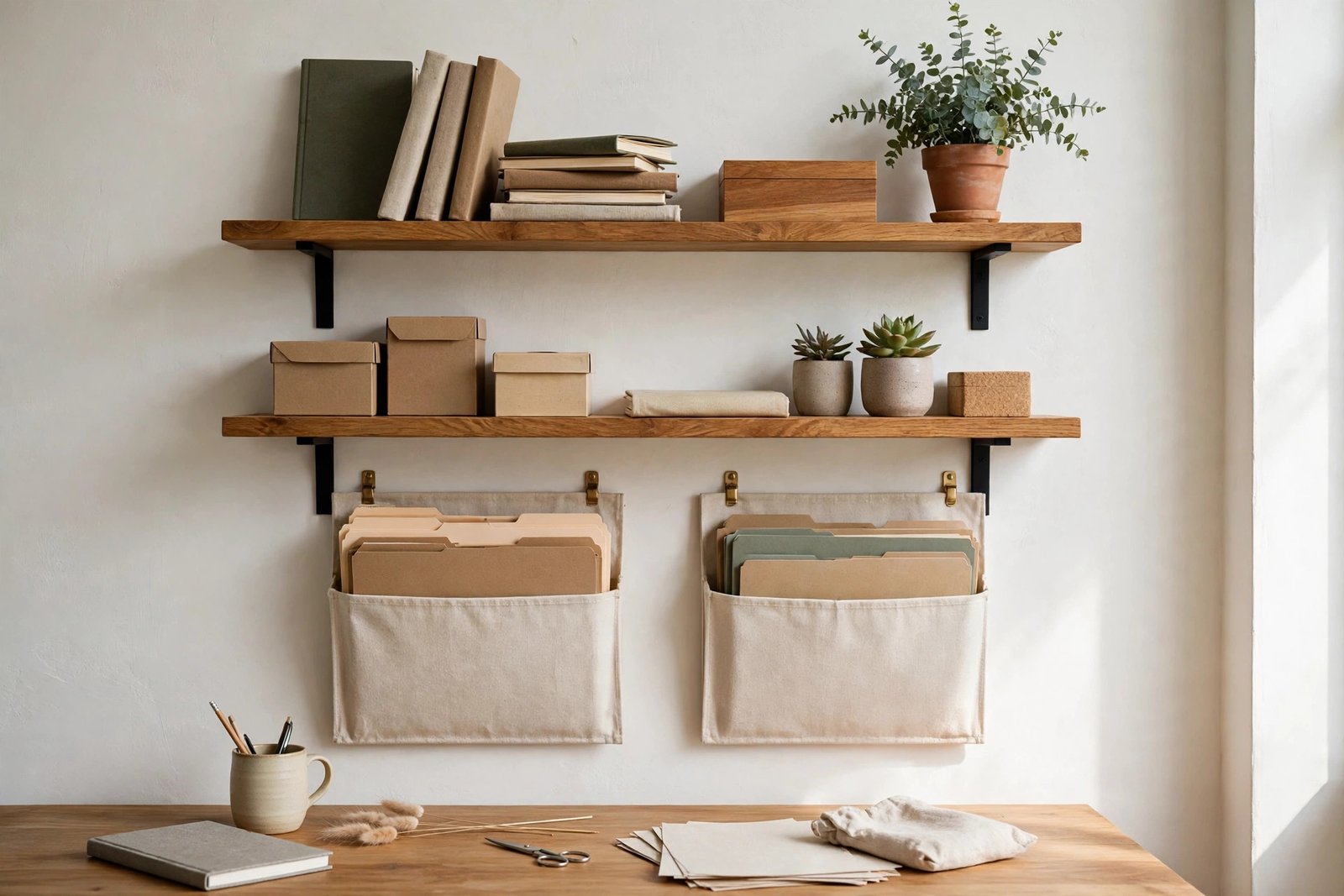
The wall above your desk is the most valuable unused space in a storage-free office. One or two shelves there hold notebooks, reference books, a small plant and the boxes for supplies, all visible and reachable without standing up. Fix shelves high enough to clear your head and your monitor when you sit, and keep the heaviest items on the lowest shelf.
Beside the desk, wall-mounted file pockets hold current papers vertically instead of in a desk pile, and a simple board with hooks or small rails takes headphones, cables in use and the tools you reach for daily. Wall storage has one more advantage in rented or shared rooms: it keeps the floor completely clear, so the room still feels like a room, not a warehouse.
Use the Space Under the Desk
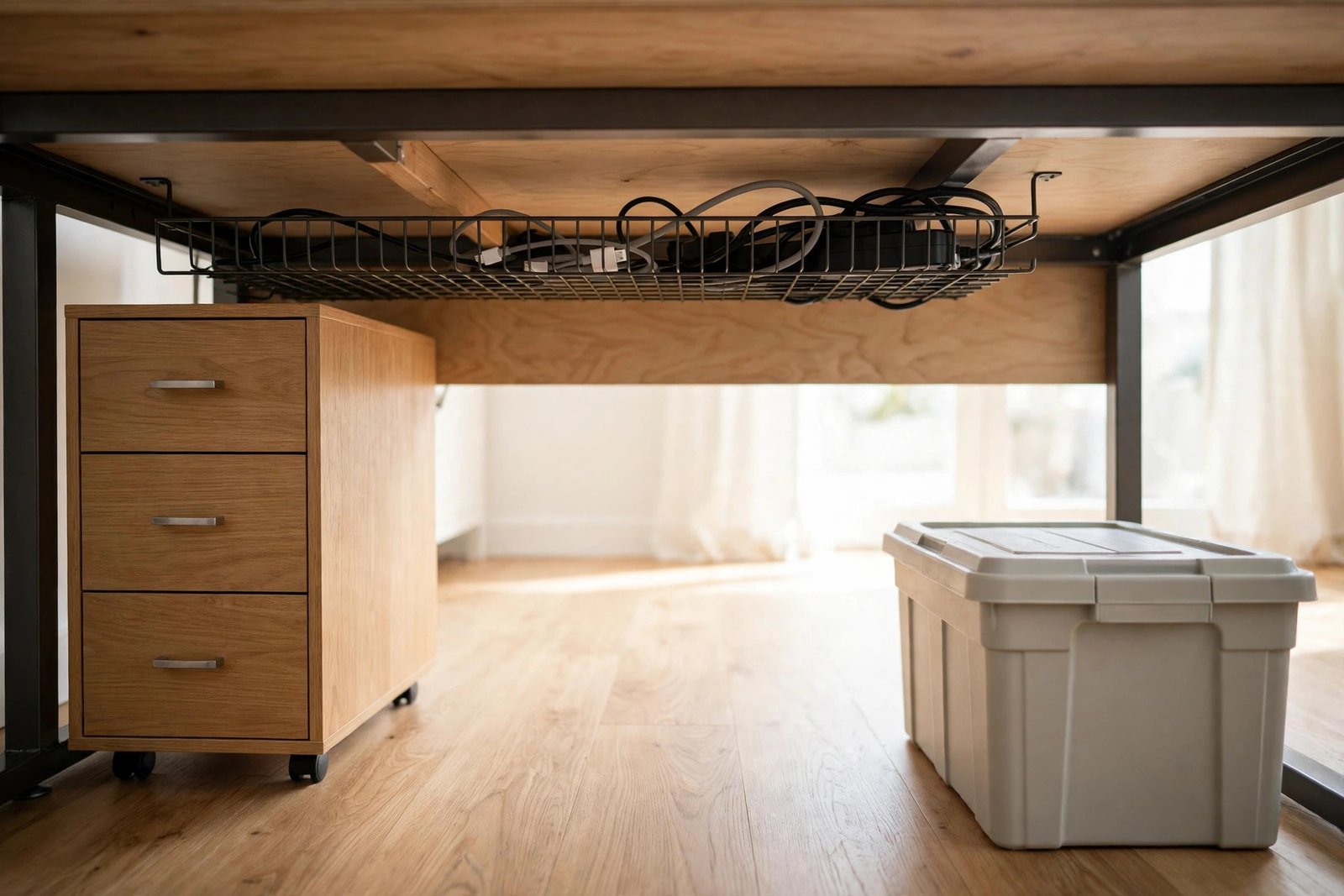
The second storage zone is already in the room and already paid for: the space under your desk. A slim drawer unit on one side, sized to leave legroom in the middle, gives you the drawers the room never came with. This is the natural home for stationery, the to-file paper folder and daily chargers.
The rest of the under-desk area takes the hidden categories. A cable tray keeps every cord off the floor and out of sight. A lidded box holds spare cables, supplies and the rarely opened items. Keep the centre clear for your legs and the far corner for the box, and the area stays comfortable rather than cramped. Under-desk storage works best alongside a tidy surface system, so the whole desk, top and bottom, follows the same logic as a storage system that keeps a desk tidy day after day.
Closed Boxes and One Flexible Piece of Furniture
For everything bulkier, closed storage is the secret to a calm small room. Matching lidded boxes on a shelf or stacked neatly in a corner hold archives, seasonal items and spare equipment without showing their contents. Label every box on the side that faces the room. A labelled closed box reads as furniture; an open box reads as mess.
If you add one piece of furniture, make it earn its place twice. A low bookcase works as storage and as a room divider or printer stand. A storage ottoman holds blankets or files and works as a footrest or spare seat. A desk with built-in drawers removes the need for a separate unit. And if your office shares a bedroom, choose closed, furniture-like storage that belongs in a sleeping room too, the same approach that keeps a home office in a bedroom feeling restful after work ends.
The Door, the Corners and the Forgotten Spots
Small rooms reward small discoveries. Behind the door fits a slim rack or a row of hooks for your bag, jacket and headphones, items that otherwise colonise the chair and floor. The corner beside the desk takes a tall, narrow shelving unit or stacked boxes where a wide unit would never fit. The gap between a bookcase and the wall often fits rolled plans, wrapping paper or a spare whiteboard stored vertically.
Finally, give daily arrivals a parking spot: one hook or one small tray near the door for keys, post and the things in your hands when you walk in. Arrivals with a parking spot never reach the desk, and the desk stays a workspace instead of the room’s only surface.
Mistakes to Avoid
- Buying furniture before listing what needs storing. Measure your categories first; the wrong-sized unit wastes the scarcest thing you have, which is space.
- All open storage. Open shelves full of mixed items make a small room feel chaotic; mix in closed boxes for the untidy categories.
- Blocking legroom. Under-desk storage that crowds your legs will be removed within a week, system and all.
- Storing daily items far from the chair. Anything you must stand up for will migrate to the desk permanently.
- Unlabelled boxes. A box you cannot identify becomes a box you open every time, and soon a box you ignore.
- Trying to store everything in the room. Rarely used archives can live in a hallway cupboard or another room; the office only needs what the work needs.
Frequently Asked Questions
What is the first storage I should add to an office with none?
One or two shelves above the desk. They cost little, fit almost anywhere, and immediately take notebooks, supplies and reference material off the surface. Add the under-desk drawer unit second, and you have covered the two zones that handle most office clutter.
How do I store things if I cannot drill into the walls?
Use freestanding and over-door options instead: a tall narrow bookcase, stacking boxes, an over-door hook rack, and a drawer unit under the desk. Adhesive hooks and picture strips handle light items like headphones and in-use cables without leaving marks.
Where should a printer go in a small office with no cupboard?
On top of a low bookcase or storage unit, on a sturdy shelf, or on a small stand beside the desk. Keep paper and spare ink in a closed box directly below or beside it, so the whole printing category lives in one zone.
How do I stop the room looking like a storage unit?
Favour closed storage in a small number of matching boxes and units, keep open shelves for books and a few calm items only, and leave some wall and floor visibly empty. A small office looks like an office when work items are near the desk and storage stays quiet at the edges.
Conclusion
An office with no built-in storage is not an office with no storage options. Shelves claim the walls, a drawer unit and boxes claim the space under the desk, closed boxes calm the corners, and hooks finish the job behind the door. List your categories, match them to reach zones, and add pieces one at a time. The room will hold everything you need, and the desk will finally be free for the one thing it was always meant for: the work.