
Some offices have no window at all. Others have a window that faces a wall, or a desk pushed into the far corner of a room where daylight never really arrives. If that sounds like your workspace, you have probably already watched a plant slowly fade there and wondered what you did wrong.
The honest answer is that a plant in a dark office is fighting a hard battle. Light is food for a plant. Without enough of it, even a healthy plant weakens over time. The good news is that there are realistic options. Some plants cope with low light for a long time, a small grow light can replace the missing window, and a simple rotation habit can keep plants healthy without turning plant care into a second job.
This guide explains what “no natural light” really means for a plant, which options are honest and which are wishful thinking, and how to set things up so your office plants stay alive for years, not weeks.
Quick Answer
No real plant thrives forever in complete darkness, so be realistic. In a low-light office, choose proven shade-tolerant plants such as a snake plant, ZZ plant or pothos, and place them where they catch whatever light exists. In a truly windowless office, add a small LED grow light on a timer, or rotate two plants between your desk and a brighter room. If neither is possible, a good-quality fake plant is the honest choice for that spot.
First, Be Honest About How Dark Your Office Is
“Dark” means different things in different rooms, and the right choice depends on which one you have.
Low light, but not zero
Most “dark” offices are actually low-light offices. There is a window somewhere in the room, but your desk is far from it, or the window is small or faces north. Light reaches your desk, just weakly. Many tough plants can live in this kind of light for years, growing slowly but staying healthy.
Truly no natural light
A windowless internal office, a basement room or a space lit only by ceiling lights is different. Ceiling lights that feel bright to your eyes are far too weak for a plant. A plant in this space is slowly running out of energy, and no choice of species changes that on its own. This is the situation where a grow light or a rotation habit stops being optional.
A simple test helps: at midday, hold your hand about 30 centimetres above your desk. If you can see a soft, clear shadow, there is some usable plant light. If you can barely see a shadow at all, treat the spot as no-light, not low-light.
Option 1: Choose Plants That Genuinely Tolerate Low Light
If your office is low-light rather than pitch dark, plant choice does most of the work. Look for plants that store energy and grow slowly, because they can coast through dull weeks that would finish a thirstier, faster plant.
- Snake plant. Thick leaves store water and energy, and it tolerates low light better than almost any common desk plant.
- ZZ plant. Its thick underground stems store reserves, so it handles dim corners and missed care calmly.
- Pothos. Trails happily in modest light, though its leaf markings fade and growth slows as light drops.
- Cast iron plant. Slow and unfussy, it was famous in dim Victorian halls long before it reached modern offices.
- Peace lily. Copes with low light and tells you clearly, by drooping, when it needs a drink.
For a fuller comparison of shade-tolerant choices and how to judge the light at your own desk, see our guide to the best low-light plants for a desk far from a window. Even with tolerant plants, help them: keep leaves dust-free so they can use the little light they get, and turn the pot a quarter turn each week so the plant grows evenly instead of leaning hard toward the room’s one brighter side.
Option 2: Add a Small Grow Light
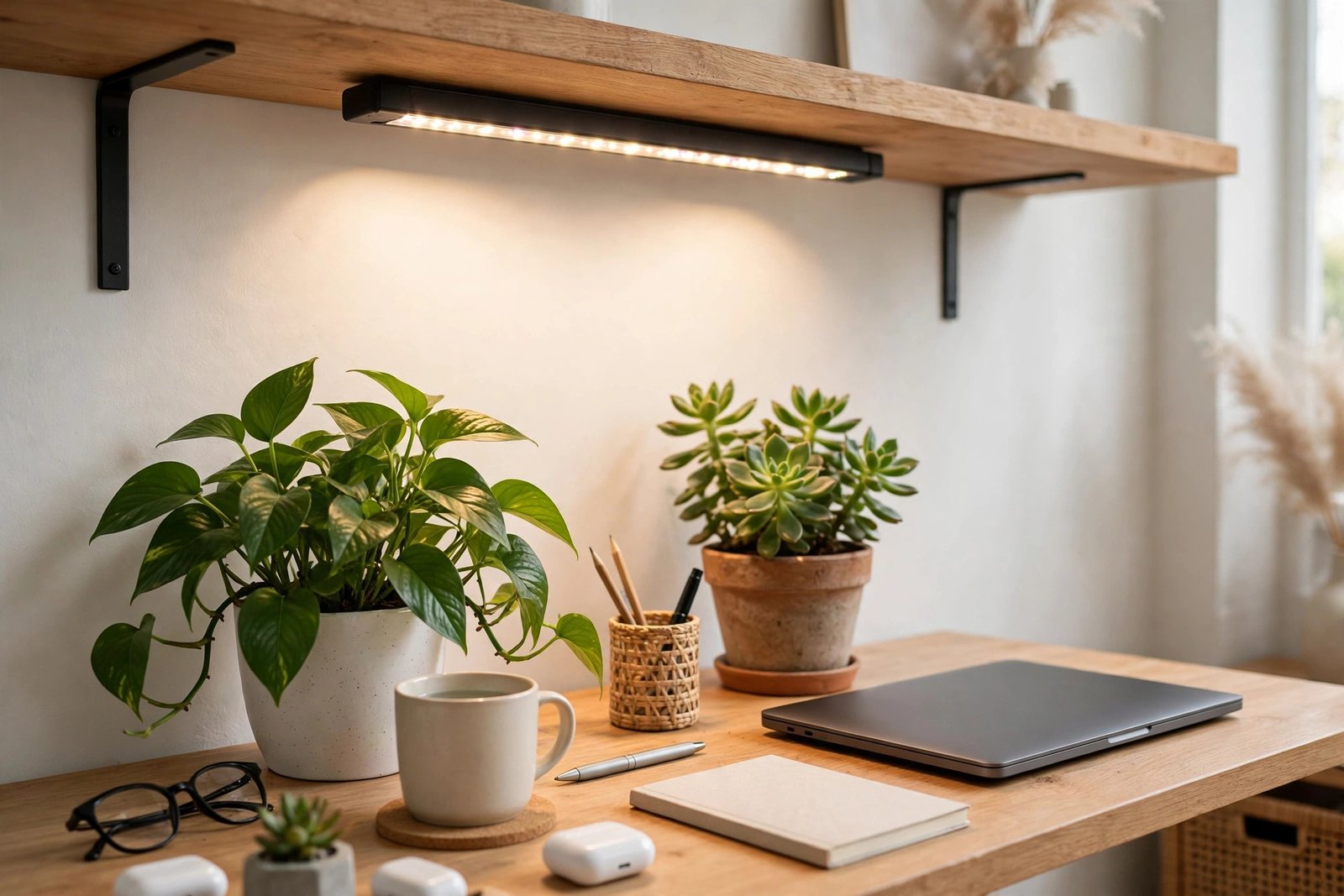
In a truly windowless office, a grow light is the one fix that actually replaces the missing window. It does not need to be large, expensive or ugly. A small LED grow bulb in a normal desk lamp, or a slim bar light fixed under a shelf, is enough for one or two desk plants.
Keep it simple:
- Distance. Place the light roughly 20 to 40 centimetres above the plant. Too far away and it does little; almost touching the leaves is too much.
- Hours. Plants in nature get long days. Aim for around 10 to 12 hours of light, and use a cheap plug timer so you never have to remember.
- Colour. Choose a warm or natural white grow light rather than a purple one. Your office will look normal, and you can work under it comfortably.
- Position. Light from above or slightly to one side looks natural and keeps growth compact.
If your whole office feels gloomy, the problem may be bigger than the plants. Our article on why a home office feels dark even with the lights on covers the room lighting fixes that help you as well as your plants.
Option 3: Rotate Plants Between Rooms
If you have a brighter room at home, rotation is a free and surprisingly effective system. Keep two similar plants. One lives on your desk for two to four weeks while the other rests in a bright spot, such as a kitchen windowsill. Then swap them.
The resting plant rebuilds its energy in good light, so neither plant spends long enough in the dark to decline. Rotation works best with tough, portable plants in medium pots. It fails when the pot is huge, the plant is fragile, or the “bright” resting spot is not actually much brighter than the desk. Mark the swap day on your calendar next to another routine, such as the end of the month, so it actually happens.
Option 4: Accept a Fake Plant for the Darkest Spot
Sometimes the realistic option is not a real plant at all. If a shelf or corner gets no light, has no space for a grow light, and rotation is impractical, a decent fake plant will look better in six months than a real plant struggling there. Spend a little more on one with varied leaf tones and a simple pot, dust it now and then, and save your real plants for spots where they have a fair chance.
Keeping Dark-Office Plants Alive: The Small Habits
Whatever option you choose, low light changes how you care for the plant. A plant using little light also uses little water, so its soil stays wet much longer than the same plant on a windowsill. Water sparingly and only when the soil has dried well down. More plants die in dark offices from soggy soil than from the darkness itself.
Feed rarely or not at all in winter and dull periods, because a plant that is barely growing cannot use the food. And watch for the early warning signs of a plant running low on light: long, stretched gaps between leaves, new leaves much smaller than the old ones, and soil that never seems to dry. Those signs mean move the plant, add light, or start rotating, not water more.
If your schedule is part of the problem, pair your dark-office plant with one of the forgiving choices in our guide to low-maintenance office plants, so a busy month does not undo your setup.
Mistakes to Avoid
- Buying a sun-loving plant for a dark desk. Succulents, cacti and herbs need strong light. In a dark office they stretch, pale and fade, however well you water them.
- Believing “low light” on a label means “no light”. Low-light tolerant plants still need some light. The label describes shade, not a cupboard.
- Watering on a bright-office schedule. Dark-office soil dries slowly. A weekly watering habit that suits a sunny desk can rot roots in a dim one.
- Hiding the plant behind a monitor or curtain. Even in a room with a window, a blocked spot can be the darkest place in the office.
- Adding plant food to fix pale leaves. Pale, stretched growth in the dark is a light problem. Food cannot replace light and can harm weak roots.
- Giving up after one death. One failed plant usually means the spot was darker than you thought. Adjust the system, not just the plant.
Frequently Asked Questions
Can any real plant survive in an office with no windows?
Not on room light alone, no. A tough plant may look fine for a few months on stored energy, but it slowly weakens. With a small grow light on a timer, or a rotation with a brighter room, real plants can stay healthy in a windowless office for years.
How many hours should a grow light stay on?
Around 10 to 12 hours a day suits most desk plants and matches a natural long day. A plug timer makes this automatic. Keep the light 20 to 40 centimetres above the plant, and give the plant a proper dark rest at night.
Which plant lasts longest in a dark corner?
The snake plant and ZZ plant are the most forgiving choices because both store reserves in their leaves and stems. Even they need some light, so treat them as low-light plants, not no-light plants, and add a grow light or rotation for a truly dark corner.
Is a fake plant a lazy choice?
No, it is often the honest one. For a spot with no light and no way to add or rotate, a realistic fake plant looks better long term than a real plant in slow decline. Many good-looking offices mix both: real plants where light allows, fake ones where it does not.
Conclusion
Plants for an office with no natural light are a solvable problem once you are honest about the light you actually have. In low light, choose tolerant plants and care for them gently. In true darkness, add a small grow light or rotate plants through a brighter room. And for the one impossible corner, choose a good fake without guilt. Match the option to the spot, and your office can stay green all year.
1 thought on “Plants for an Office With No Natural Light: Realistic Options”