
A plant can make a desk feel calmer and more personal, but on a small desk every centimetre counts. A plant that spreads, trails across your keyboard or needs constant tidying quickly turns from a pleasure into one more thing in your way. The answer is not to skip plants. It is to choose small desk plants that stay compact, and to place them where they never compete with your work.
This guide explains what “small” really means on a desk, lists compact plants that keep their shape, and shows you where to put them so your workspace stays clear. Every plant here was chosen for one quality above all: it minds its own business.
Quick Answer
The best small desk plants are haworthia, small peperomia varieties, a young snake plant, a small pothos kept trimmed, and a compact ZZ plant. Look for plants in pots of about 6 to 10 centimetres that grow slowly and hold an upright or tidy shape. Place the plant at the back corner of the desk, on a monitor riser or on a shelf, never in the centre of your working area, and it will never take over.
- Choose by adult size and growth speed, not by how small the plant looks in the shop.
- Upright shapes use vertical space and leave the desk surface free.
- A saucer or tray under the pot protects the desk and defines the plant’s spot.
- One well-placed plant usually looks better than three squeezed together.
What “Small” Really Means on a Desk
A plant can be small in two different ways: a small pot, and a small footprint as it grows. The second one matters more. Many plants are sold tiny and then double in size within a year, while others barely change. Before you buy, check the plant’s expected height and spread, and how fast it grows. Slow growers are your friends on a desk.
Height matters too. A plant that sits in your eye line to the monitor, or brushes your arm as you type, will annoy you daily no matter how pretty it is. Measure the space you actually have: the back corner of a typical desk fits a pot of about 10 centimetres across, and plants up to roughly 25 centimetres tall stay below most monitor screens. If your whole arrangement is tight, our guide to a small desk setup that still fits a monitor, laptop and notebook shows how to plan the space before adding anything decorative.
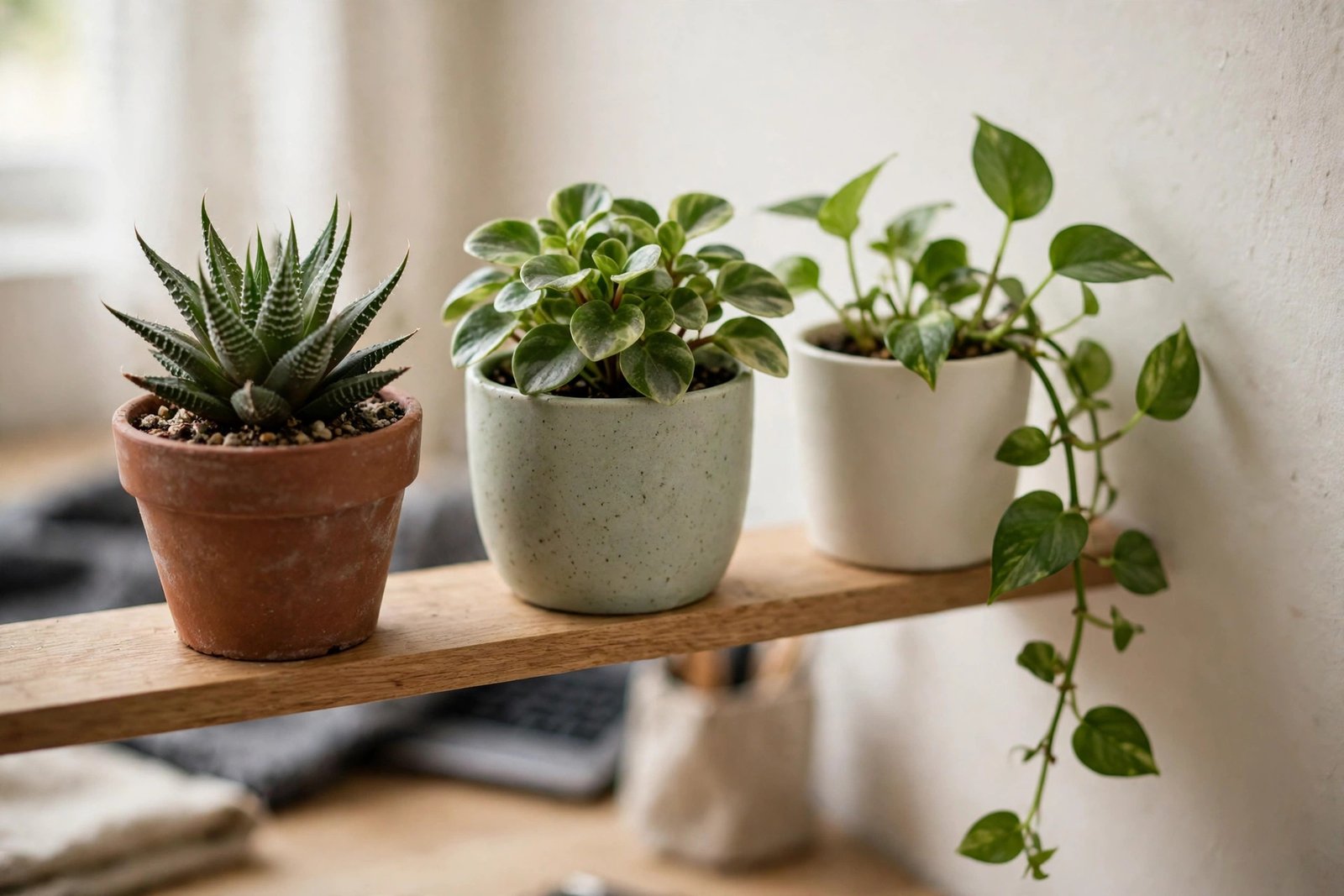
Compact Plants That Keep Their Shape
Haworthia
Haworthia forms a neat rosette of thick, patterned leaves and grows very slowly. It stays in a small pot for years, asks for little water, and never trails or leans. It prefers bright indirect light, so it suits a desk that gets decent daylight without direct sun on the leaves.
Peperomia
Peperomias are a varied family, but most desk varieties stay compact and bushy rather than spreading. Their leaves come in many textures and patterns, they tolerate average room conditions, and they are content in small pots. A peperomia is a good choice if you want one plant with a bit of character that still behaves.
Small Snake Plant
Compact snake plant varieties grow upright, narrow leaves that take almost no horizontal space. They tolerate low light and missed waterings, and their vertical shape means they can stand behind a monitor or in a back corner without leaning into your workspace. Choose a dwarf variety if you want it to stay truly small.
A Small Pothos, Kept Trimmed
Pothos wants to trail, but it does not have to take over. Kept in a small pot on a shelf or stand and trimmed a few times a year, it stays a tidy mound with a few short trails. The moment a stem reaches your keyboard, snip it. Pothos also tolerates the dimmer corners, which is why it also appears in our list of the best low-light plants for a desk.
Compact ZZ Plant
A young ZZ plant in a small pot is tidy, upright and extremely forgiving. It grows slowly, especially in modest light, so a small one stays small for a long time. Its glossy leaflets look smart next to office equipment, and it shrugs off the occasional forgotten watering.
Air Plants
If you truly have no surface space, an air plant (tillandsia) needs no pot and no soil at all. Rest it on a small stand, a shelf edge or a wall-mounted holder, and soak it in water briefly every week or two. It takes up almost nothing and adds a sculptural shape to a shelf.
Where to Put a Small Plant So It Never Gets in Your Way
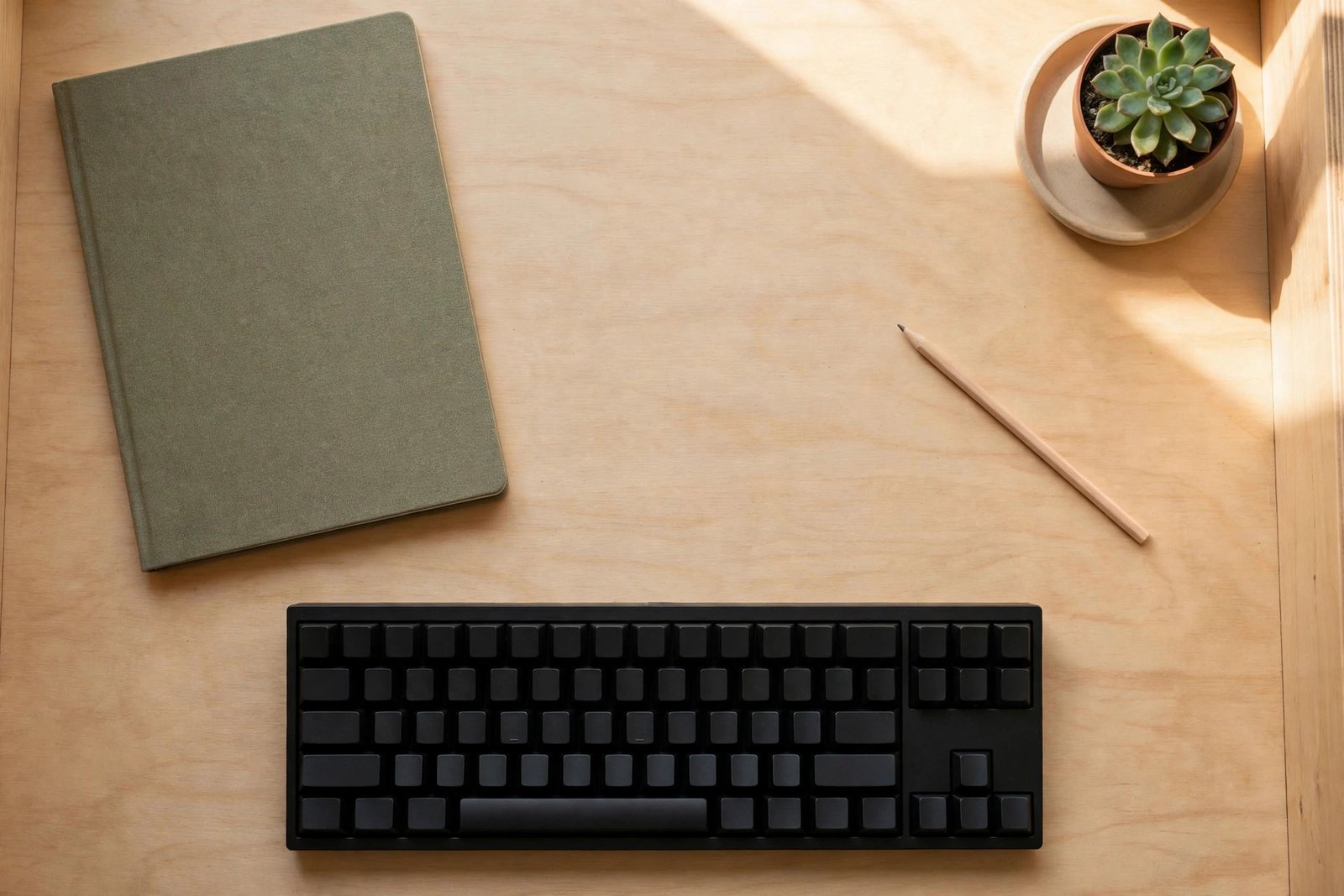
Placement decides whether a small plant stays a pleasure. The back corner of the desk is the classic spot: visible, enjoyable, and outside the triangle between you, your keyboard and your notebook. On top of a monitor riser or a small shelf works just as well, and it lifts the plant closer to the light at the same time.
A wall shelf above or beside the desk is even better for trailing plants, because the stems can hang in empty air instead of across your papers. Plants also soften a bare outlook; if your desk faces a wall, the ideas in our guide to decor fixes for a desk that faces a wall show how a little greenery near eye level changes the feel of the whole setup. What matters is simply this: decide the plant’s home first, and do not let it drift into your working area over time.
Pots, Saucers and Protecting Your Desk
Always stand the plant on a saucer or a small tray. It catches the odd drip, protects the desk surface from rings and scratches, and quietly marks the boundary of the plant’s territory. Use a pot with a drainage hole inside a slightly larger outer pot, and water at a sink when you can, letting the plant drain before it goes back to its spot.
Choose a pot that is stable rather than top-heavy. Small plants get knocked during cleaning and cable wrangling, and a sturdy pot with a wide base saves both the plant and your keyboard from a soil spill.
A Two-Minute Weekly Care Routine
- Check the soil with a fingertip. Water only if the top couple of centimetres are dry.
- Turn the pot a quarter. Even growth, no leaning toward the window.
- Trim anything reaching into your space. One snip now prevents a tangle later.
- Wipe dusty leaves. Clean leaves take in light better and look sharper on video calls.
That is genuinely all most compact desk plants need. If a plant regularly needs more than this, it is the wrong plant for a busy desk, and swapping it is a better answer than struggling on.
Mistakes to Avoid
- Buying by shop size, not adult size. A tiny plant that grows fast will own your desk within a year.
- Putting the plant in the middle of the desk. It will be moved, knocked and resented. Give it a corner or a shelf from day one.
- Letting trailers reach the keyboard. Trim trailing stems early and often; they root where they touch and tangle with cables.
- Using a pot with no drainage on a wooden desk. Hidden water damages both the plant’s roots and the desk surface.
- Crowding three plants onto a tiny desk. One healthy plant in the right spot looks better and is easier to keep alive.
Frequently Asked Questions
What is the smallest plant I can keep on a desk?
An air plant or a small haworthia in a 6 centimetre pot are about as small as living desk plants get. Both stay compact for years. If even that is too much, a single stem of pothos in a small glass of water on a shelf takes almost no room and needs only a water top-up.
How do I stop a plant from spreading across my desk?
Choose upright or rosette plants rather than natural spreaders, keep the pot small, and trim any stem that leaves its zone the moment you notice it. Most takeover problems come from trailing plants that were never trimmed, not from the plant growing unusually fast.
Can a small plant survive on a desk far from a window?
Some can. Compact snake plants, small ZZ plants and a trimmed pothos all cope with low light, though they will grow even more slowly, which on a small desk is often an advantage. Avoid succulents there, since most need brighter light to keep their shape.
Where exactly should I place the plant on my desk?
At a back corner, on a monitor riser, or on a shelf above or beside the desk. Keep it out of the area swept by your arms, notebook and laptop lid, and off any spot where it blocks your screen or your light. If it is visible when you look up from your screen, it is in a good place.
Conclusion
Small desk plants succeed when the plant, the pot and the place are all chosen with space in mind. Pick a slow, compact grower such as haworthia, peperomia or a dwarf snake plant, give it a corner or a shelf with a saucer underneath, and spend two minutes a week keeping it in bounds. Your desk stays a workspace first, with exactly as much green as it can comfortably hold.
